
Most people think great coaching means a strict plan, a fixed schedule, and a coach who tells you exactly what to do. That assumption is holding a lot of people back. Flexible coaching refers to adaptive approaches that adjust style, intensity, or structure based on your readiness, context, and needs at any given moment. It's the opposite of one-size-fits-all, and when you pair it with AI-driven tools, it becomes one of the most powerful systems available for building real accountability in fitness, productivity, and mental well-being.
Table of Contents
- What is flexible coaching?
- How does flexible coaching work?
- Benefits of flexible coaching for accountability
- Flexible coaching and AI: A powerful partnership
- When flexible coaching works best and its limits
- How to choose and apply flexible coaching in your life
- Get started with flexible coaching today
- Frequently asked questions
Key Takeaways
| Point | Details |
|---|---|
| Flexible coaching adapts to you | It changes approach, style, or structure according to your needs and readiness. |
| AI boosts reach and results | AI-driven flexible coaching offers 24/7 support, personalized nudges, and higher engagement and results. |
| Hybrid models offer balance | Combining human and AI support gives you both empathy and efficiency, especially for complex challenges. |
| Choose and tweak your solution | Assess your goals and select or adjust your coaching setup to maximize personal accountability and growth. |
What is flexible coaching?
Flexible coaching is not a single method. It's a philosophy that says your support system should change as you change. On a high-energy Monday, you might need a direct, task-focused push. On a rough Thursday after a bad night's sleep, you need encouragement and a lighter touch. Adaptive coaching approaches adjust style, intensity, and structure based on who you are, what you want, and what you need right now.
Traditional coaching tends to lock you into one style. You get a program, a set of rules, and a coach who applies the same framework to everyone. Flexible coaching breaks that mold by using models like the GROW Model (Goal, Reality, Options, Will) and the Situational Coaching Model, which assess readiness and adapt styles from directing to delegating based on your current ability and willingness.
Here's a quick comparison of coaching approaches:
| Approach | Style | Adapts to you? | Best for |
|---|---|---|---|
| Traditional coaching | Fixed, prescriptive | Rarely | Structured learners |
| Flexible coaching | Adaptive, situational | Yes | Most individuals |
| AI-driven coaching | Automated, data-based | Continuously | Busy, self-motivated users |
For AI coaching and productivity, flexible coaching is the foundation that makes personalized automation possible. Without adaptability built into the system, AI tools are just fancy reminders.
"The best coaching relationship is one that evolves with the person. Rigid systems create compliance. Adaptive systems create growth." — Coaching research consensus on situational models
How does flexible coaching work?
Flexible coaching operates through a clear cycle: assess, adapt, and adjust. It's not complicated, but it does require honest self-reflection and a system that can respond to what you find. Here's how it works in practice:
- Assess your readiness. Before any session or check-in, the system (or you) evaluates your current ability and willingness. Are you energized and focused, or drained and distracted? This shapes everything that follows.
- Choose the right approach. Based on your readiness, the coaching style shifts. High ability and high willingness means you get autonomy and delegation. Low ability or low willingness means you get direction and structure. Adapting styles from directing to delegating is the core mechanic of situational coaching.
- Apply a framework. Models like the GROW Model guide the conversation through Goals, Reality, Options, and Will. This keeps sessions focused without being rigid.
- Track and adjust. As you progress, your readiness level changes. The coaching style updates to match. A fitness beginner who becomes intermediate needs less direction and more challenge.
- Review regularly. Weekly or monthly reviews catch drift early. If your goals shift, your coaching approach shifts with them.
For example, imagine someone using AI-driven self-improvement tools for a running goal. In week one, they need step-by-step guidance. By week six, they need accountability nudges and performance data. Data-driven coaching makes this transition seamless because the system reads your behavior and adjusts automatically.

Pro Tip: At the start of each week, rate your energy and motivation on a scale of 1 to 10. Share that number with your coaching app or journal it. This single habit helps you and your system choose the right support style before the week even starts.
Benefits of flexible coaching for accountability
Understanding the mechanics leads right into why so many people are adopting flexible coaching. The benefits are not just theoretical.
- It fits your real life. Flexible coaching adapts to busy schedules, shifting priorities, and unpredictable weeks. You don't fall off the wagon just because life got complicated.
- Automated nudges keep you consistent. Instead of waiting for a weekly call, you get real-time adjustments and reminders that match your current context.
- AI makes it accessible 24/7. No scheduling, no waiting. Support is available when you actually need it, not just when a human coach is free.
- Engagement stays high. Because the coaching feels relevant to your current state, you're far less likely to disengage or quit.
- It works across areas. Whether you're tracking workouts, managing a project, or building a mindfulness habit, flexible coaching applies the same adaptive logic.
Stat callout: AI coaching increases coaching actions by 88%, builds a similar alliance to human coaches, and boosts performance by 36%. Those are not small gains.
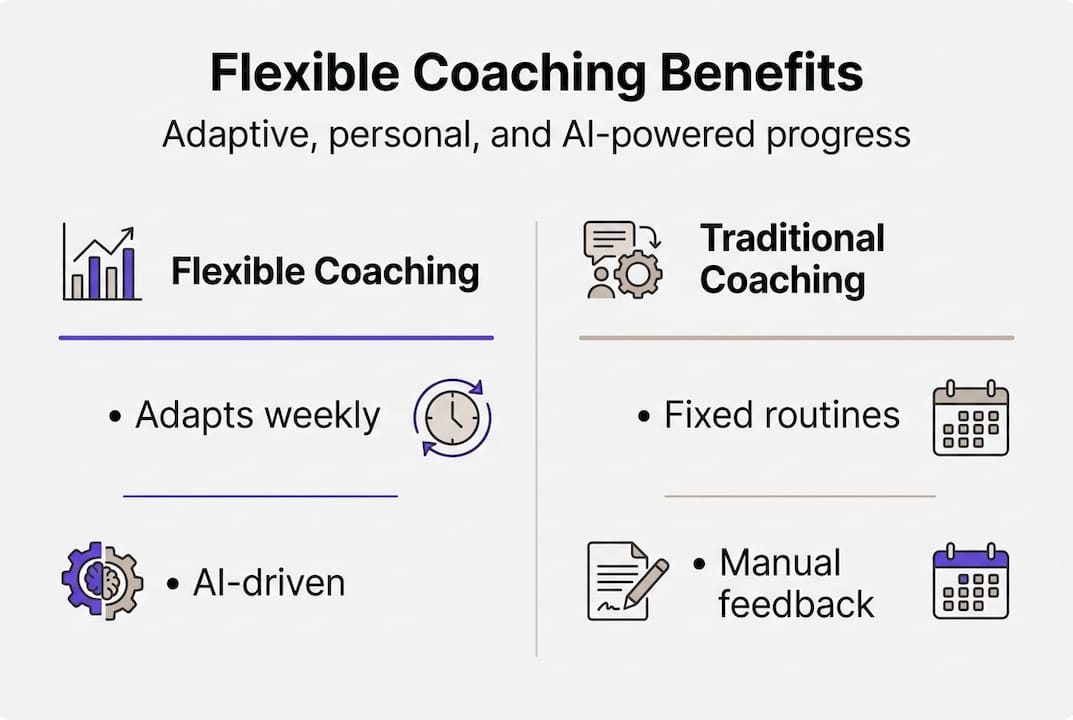
For AI personal development, flexible coaching is the engine behind consistent progress. It's also why AI voice coaching has shown strong results for goal adherence among busy professionals. When the system meets you where you are, you show up more often.
Flexible coaching also removes the guilt spiral. Traditional systems make you feel like a failure when you miss a day. Flexible systems recalibrate and move forward. That psychological shift alone makes a measurable difference in long-term adherence.
Flexible coaching and AI: A powerful partnership
AI takes flexible coaching from a concept to a real-time, always-on system. Here's what that looks like in practice: your AI coach reads your check-in data, notices you've been skipping evening workouts, and automatically shifts your schedule to mornings. No human coach could do that at scale, at any hour, for a low monthly cost.
AI enables scalability with 24/7 access and low cost, while retaining engagement through nudges. It outperforms static apps but requires clear data privacy safeguards to build user trust.
Here's how the options compare:
| Feature | AI coaching | Traditional coaching | Static apps |
|---|---|---|---|
| Cost | Low | High | Low |
| Availability | 24/7 | Scheduled only | 24/7 |
| Personalization | High, data-driven | High, relationship-driven | Low |
| Accountability boosts | Strong (88% action increase) | Strong | Weak |
| Privacy controls | Varies by platform | Confidential | Varies |
One critical distinction: specialized AI coaching tools significantly outperform generic AI chatbots. Specialized AI outperforms general LLMs by 48 to 108% in accountability focus. That gap matters when you're trying to build a real habit, not just have a conversation.
For AI and accountability data, the quality of the system's data collection directly determines how well it can adapt. And for coaching privacy strategies, knowing how your data is used builds the trust that makes the whole system work.
Pro Tip: Before committing to any AI coaching platform, check two things: does it let you customize your goals and coaching style, and does it clearly explain how your data is stored and used? If either answer is vague, keep looking.
When flexible coaching works best and its limits
To get the most out of flexible coaching, you need to know where it shines and where it falls short.
Where flexible and AI coaching excel:
- Building and maintaining daily habits
- Accountability for fitness, productivity, and well-being goals
- Routine adjustments based on real-time data
- Consistent check-ins without scheduling friction
- Motivation through milestone tracking and celebration
Where it struggles:
- Handling deep emotional crises or trauma
- Providing physical guidance or injury rehabilitation
- Reading subtle emotional cues that require human empathy
- Complex motivational blocks that need real relationship depth
AI lacks emotional nuance and physical spotting, making it best suited for motivated users. Over-automation carries real risks, and a human-AI hybrid is recommended for complex needs like injury rehab or deep motivational work.
"Pure AI suits routine accountability well. But for empathy, motivation, and complex personal challenges, the human element remains essential. A hybrid model is not a compromise — it's the smart choice." — Expert consensus on progressive coaching models
Success requires hybrid models where AI handles the data and consistency layer while humans step in for empathy and motivation. For most accountability goals, AI alone is enough. For deeper personal work, hybrid coaching benefits are well documented and worth exploring.
The honest truth is that flexible coaching is not magic. It works best when you're already somewhat motivated and just need the right structure and reminders to stay on track.
How to choose and apply flexible coaching in your life
Armed with an understanding of the pros and cons, here's how to pick and use flexible coaching for your specific situation.
- Clarify your primary goal. Fitness, productivity, mental well-being, or a mix? Your goal type shapes which coaching features matter most. Flexible coaching excels in automated, accessible support across all three areas.
- Assess your current readiness. Are you a beginner who needs structure, or an intermediate who needs accountability? Honest self-assessment here saves you from choosing the wrong tool.
- Decide on AI, human, or hybrid. If your needs are primarily about consistency and habit tracking, AI is likely enough. If you're navigating something emotionally complex, add a human element.
- Personalize your setup. Set specific, measurable goals in your chosen platform. Share relevant data like sleep, energy, or workout logs so the system can actually adapt to you.
- Review and adjust monthly. Flexible coaching only stays flexible if you update your goals and preferences as you grow. Schedule a monthly review to check what's working and what needs to change.
- Protect your privacy. Only share data you're comfortable with. Read the platform's privacy policy before connecting health or productivity data.
For AI accountability for personal goals, the setup phase is the most important. And for behavioral coaching success, consistency in reviewing and adjusting your approach is what separates people who hit their goals from those who plateau.
Get started with flexible coaching today
Ready to make flexible coaching a reality in your life? The gap between knowing what works and actually doing it is exactly where most people get stuck, and that's where the right tool makes all the difference.
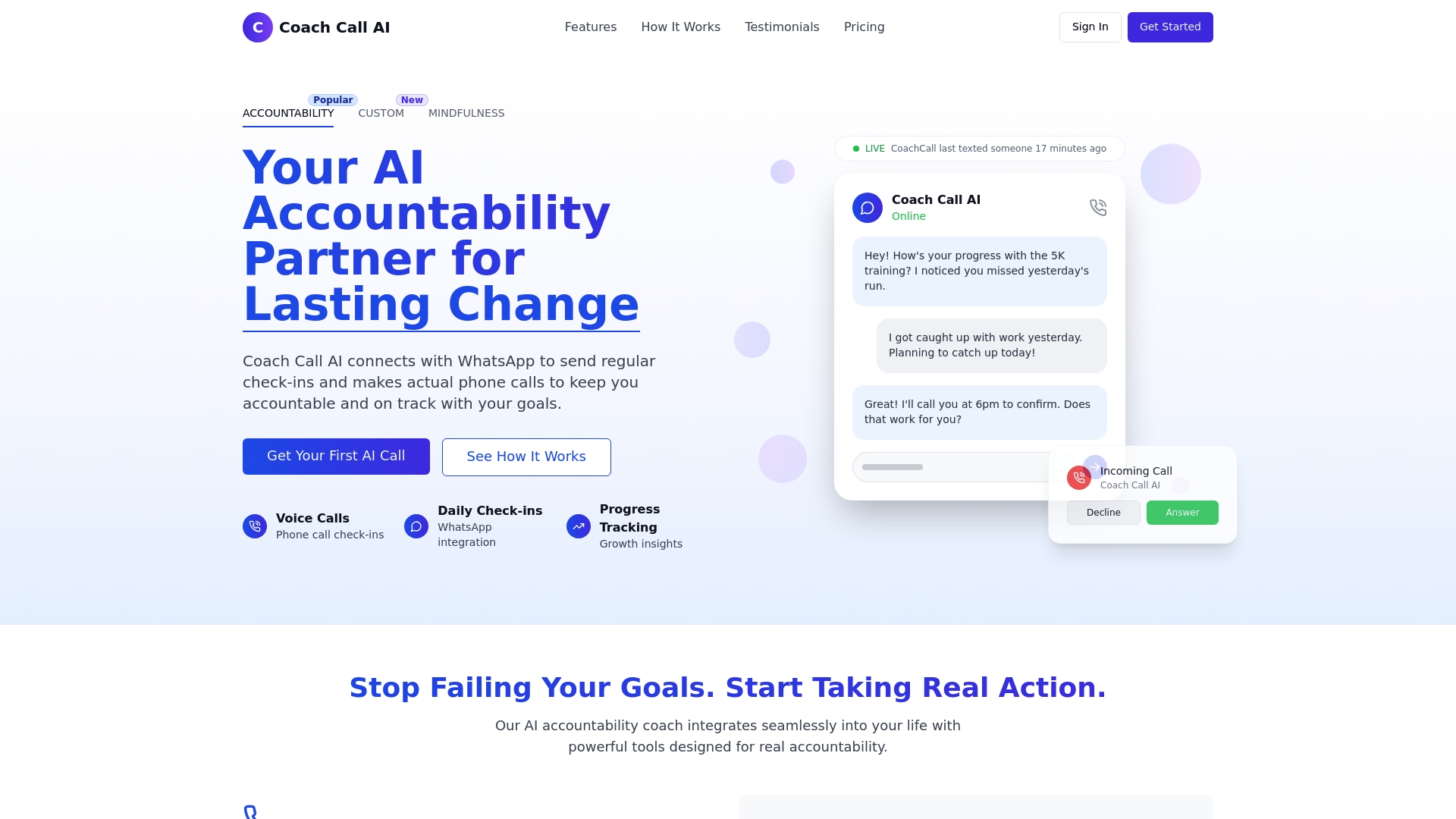
Coach Call AI is built specifically for people who want flexible, AI-driven accountability without the cost or scheduling friction of traditional coaching. It integrates directly with WhatsApp, so your check-ins, motivational messages, and scheduled voice calls happen inside an app you already use every day. Whether your focus is fitness, productivity, or mental well-being, Coach Call AI adapts to your goals, tracks your progress, and celebrates your wins automatically. It's the kind of support that shows up when you need it, adjusts when life changes, and never cancels on you.
Frequently asked questions
How does flexible coaching help with accountability?
Flexible coaching adapts support in real-time, offering nudges and personalized feedback that help you stay consistent. AI coaching increases coaching actions by 88% and boosts performance by 36%, making it a measurable accountability tool.
Is AI coaching better than traditional coaching?
AI coaching is more scalable and accessible, while traditional coaching excels in empathy and deep emotional support. Specialized AI outperforms general LLMs by 48 to 108% in accountability focus, but human coaches still lead in relationship depth.
What are the risks of over-automating coaching?
Too much automation can miss emotional cues and nuanced personal needs. AI lacks emotional nuance and physical spotting ability, so a human-AI blend is often best for complex or emotionally sensitive goals.
Can I use flexible coaching for mental health or fitness?
Yes, flexible coaching is effective for fitness, productivity, and mental well-being, especially for goal-setting and habit building. AI-driven flexible coaching excels at providing automated, accessible support across all three areas.