
AI coaching platforms that use data-driven insights increase adherence by 30% compared to traditional methods. Your personal data fuels personalized interventions that sustain motivation across fitness, productivity, and mental well-being. This guide demystifies how AI transforms your biometric, behavioral, and engagement data into tailored accountability that keeps you progressing toward goals.
Table of Contents
- Introduction To Data's Role In AI Coaching
- Understanding The Role Of Data In AI-Driven Coaching
- Data-Driven Personalization For Accountability And Motivation
- Leveraging Data Insights To Enhance Coaching Effectiveness
- Comparison Of Data Roles Across Coaching Domains
- Privacy And Ethical Use Of Data In AI Coaching
- Common Misconceptions About Data In AI Coaching
- Applying Data Insights In Your Coaching Journey
- Discover Your AI Accountability Partner Today
- FAQ
Key takeaways
| Point | Details |
|---|---|
| Data enables personalized coaching | AI platforms analyze biometric, behavioral, and engagement data to create adaptive interventions tailored to your unique patterns and goals. |
| Different data types serve specific domains | Fitness relies on biometric streams, productivity tracks task completion, and mental health uses emotional and cognitive data. |
| Data insights boost motivation and adherence | Predictive analytics and progress visualization reinforce accountability through timely prompts and clear milestone tracking. |
| Privacy frameworks protect your data | Ethical AI coaching follows strict consent standards, giving you control over what data you share and how platforms use it. |
| AI complements, not replaces, human coaching | AI delivers continuous data insights and personalized feedback while human empathy and judgment remain essential for complex support. |
Introduction to data's role in AI coaching
AI coaching platforms transform raw user data into personalized accountability partners. These systems collect three main data types: biometric information from wearables, behavioral patterns from user actions, and engagement metrics from platform interactions. Understanding how AI-driven coaching platforms use real-time data to tailor interventions helps you maximize coaching effectiveness.
Your data flows from collection devices through AI algorithms that identify patterns, predict challenges, and generate personalized recommendations. An AI accountability partner processes this information continuously to adapt coaching strategies in real time. This cycle creates dynamic support that evolves with your progress.
Biometric data forms the foundation for fitness and health coaching:
- Heart rate variability indicating stress and recovery
- Sleep quality metrics showing rest patterns
- Activity levels tracking movement and exercise
- Calories burned measuring energy expenditure
- Step counts monitoring daily movement
Devices like AI sports tracking sensors capture granular performance data that guides training adjustments. Behavioral data complements biometrics by revealing how you engage with goals and respond to interventions. Together, these data streams enable AI to deliver coaching that feels remarkably personalized.
Understanding the role of data in AI-driven coaching
Biometric data captures your physical state through continuous monitoring. Heart rate sensors detect stress responses and exercise intensity. Sleep trackers analyze rest quality through movement and heart rate variability. Activity logs measure steps, distance, and calories to assess daily energy expenditure.
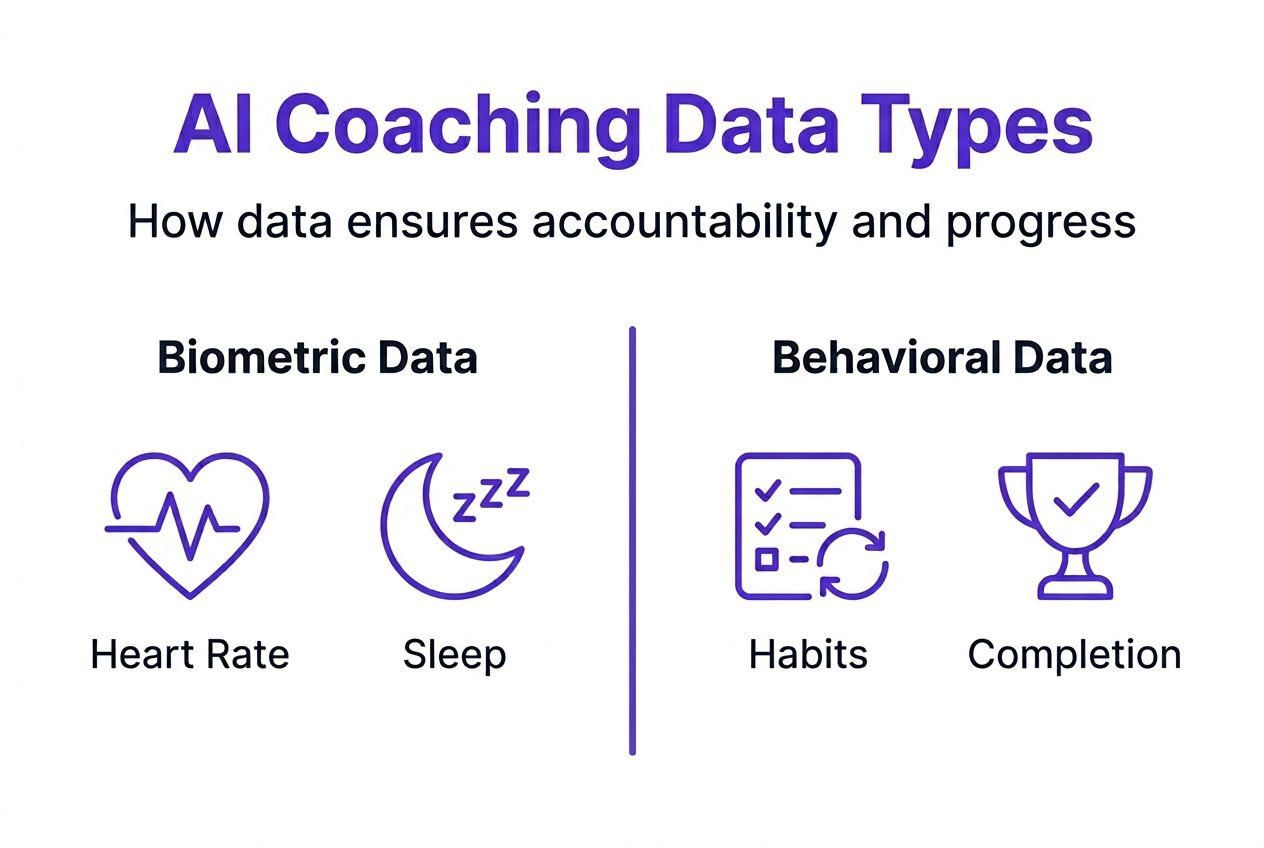
Behavioral data reveals engagement patterns that predict success or struggles. Task completion rates show productivity trends. Response times to coaching prompts indicate motivation levels. Frequency of platform interactions suggests commitment strength.
AI-driven coaching platforms use real-time data to adapt interventions instantly based on these signals. When biometric data shows declining sleep quality, AI adjusts workout intensity recommendations. When behavioral patterns indicate waning engagement, coaching prompts become more frequent and supportive.
Wearable technology enables this real-time analysis. Wearable devices like Fitbit and Apple Watch provide continuous health data streams essential for adaptive coaching. These devices sync automatically with AI platforms, creating seamless data flow that requires minimal user effort.
An AI accountability partner synthesizes diverse data sources into actionable insights:
- Morning energy levels inform optimal workout timing
- Stress indicators trigger relaxation technique suggestions
- Productivity dips prompt focus strategy adjustments
- Sleep debt accumulation adjusts recovery day recommendations
Pro Tip: Sync your wearables every morning to ensure AI coaching decisions reflect your most current physical and behavioral state.
Data-driven personalization for accountability and motivation
AI identifies behavioral patterns through machine learning algorithms that detect trends invisible to human observation. These systems recognize when you consistently skip evening workouts, struggle with Monday productivity, or experience stress spikes during specific hours. Pattern recognition enables preemptive support rather than reactive correction.
AI coaching platforms incorporate CBT techniques derived from user data analytics to tailor mental well-being interventions. Cognitive behavioral therapy principles guide how AI reframes negative thought patterns detected in journal entries or mood tracking. This therapeutic approach supports sustained mental health improvement through personalized exercises.
Personalization yields measurable benefits. Users receiving data-driven coaching show higher engagement rates and maintain goal adherence longer than those using generic programs. Adaptive feedback loops reinforce positive behaviors by celebrating small wins detected through data analysis.
Motivation reinforcement happens through several mechanisms:
- Timely encouragement when data suggests discouragement
- Progress visualization showing incremental improvements
- Goal adjustments matching current capacity
- Personalized reward timing based on achievement patterns
An AI accountability partner delivers this personalized support through natural language interactions that reference your specific data patterns. When AI notices you completed workouts five days straight, it acknowledges this streak and suggests optimal rest timing based on recovery metrics.
Pro Tip: Actively review AI feedback weekly and ask clarifying questions to deepen your understanding of behavioral patterns influencing your progress.
Leveraging data insights to enhance coaching effectiveness
Predictive analytics forecast when you might struggle based on historical patterns. AI coaching platforms use algorithms to predict behavior challenges, providing timely motivational prompts that increase adherence by up to 30%. These predictions trigger interventions before motivation wanes, maintaining momentum through challenging periods.

Data visualization and progress tracking increase user motivation by providing clear milestones and reinforcing accountability through feedback loops. Visual representations transform abstract data into concrete evidence of progress. Graphs showing strength gains, productivity trends, or mood improvements create powerful motivation.
Mental health improvements linked to AI-driven coaching include reduced anxiety, better stress management, and improved emotional regulation. Data insights reveal emotional patterns and trigger points, enabling personalized coping strategies.
AI coaching users report 30% higher adherence rates and significantly improved motivation through data-driven feedback and predictive intervention timing.
Follow these steps to maximize data insights:
- Review weekly summary reports highlighting key patterns
- Identify correlations between behaviors and outcomes
- Set specific, measurable goals based on baseline data
- Track leading indicators, not just results
- Adjust strategies when data shows plateaus
Features that boost coaching outcomes:
- Real-time biometric feedback during activities
- Automated milestone celebrations based on data thresholds
- Personalized recovery recommendations from fatigue metrics
- Adaptive difficulty scaling matching current performance
- Pattern recognition alerts for behavior changes
An AI accountability partner integrates these features into seamless coaching experiences that feel responsive and personalized. Data transforms from background noise into actionable guidance.
Comparison of data roles across coaching domains
Data-driven coaching frameworks vary between domains, requiring tailored data types and coaching approaches for optimal results. Fitness coaching prioritizes physiological metrics, productivity focuses on task completion patterns, and mental health emphasizes emotional and cognitive data.
| Coaching Domain | Primary Data Types | Key Coaching Tactics | Main Tools |
|---|---|---|---|
| Fitness | Heart rate, sleep quality, activity levels, calories burned | Progressive overload, recovery optimization, injury prevention | Wearables, fitness trackers, smart scales |
| Productivity | Task completion rates, focus duration, time allocation, goal progress | Time blocking, priority management, habit formation | Task apps, calendar integration, screen time tracking |
| Mental Health | Mood ratings, stress indicators, journal entries, cognitive patterns | CBT exercises, mindfulness prompts, emotional regulation | Mood trackers, meditation apps, journaling platforms |
Fitness coaching uses biometric data from wearables to adjust training intensity and prevent overtraining. Real-time heart rate monitoring guides workout zones while sleep tracking informs recovery needs. This physiological focus creates measurable performance improvements.
Productivity coaching analyzes behavioral and engagement metrics to identify time management patterns. Task completion rates reveal when you work most effectively. Engagement data shows which strategies maintain focus versus causing burnout.
Mental health coaching relies on emotional and cognitive data captured through mood tracking and journaling. AI detects patterns in emotional responses and suggests therapeutic techniques matched to specific triggers.
Choosing the right AI coaching tool:
- Prioritize platforms specialized in your primary goal area
- Verify compatibility with your existing tracking devices
- Assess data visualization quality for your learning style
- Check privacy controls matching your comfort level
- Test integration capabilities with other productivity or health tools
An AI accountability partner can address multiple domains simultaneously by synthesizing diverse data streams into cohesive support across fitness, productivity, and well-being goals.
Privacy and ethical use of data in AI coaching
Privacy and ethical data use follow standards such as the International Coaching Federation AI Coaching Standards ensuring data transparency and user control. These frameworks mandate explicit consent for data collection and clear communication about how platforms use your information.
Ethical AI coaching platforms implement bias mitigation strategies to ensure fair treatment across diverse user populations. Algorithms undergo regular audits to identify and correct discriminatory patterns. Transparent documentation explains how AI makes coaching decisions.
User consent requires more than clicking "agree." Ethical platforms provide granular controls over which data types you share and how long platforms retain information. You maintain the right to delete data and understand exactly what AI analyzes.
Protect your privacy while using AI coaching:
- Review privacy policies and data retention terms before sharing sensitive information
- Use granular permission controls to limit data collection to essential metrics
- Regularly audit what data you've shared and delete unnecessary information
- Choose platforms with clear data deletion and export options
- Verify encryption standards for data transmission and storage
Reputable platforms prioritize security through encryption, secure servers, and regular vulnerability testing. Compliance in AI automation ensures adherence to regulations protecting health information. Secure AI systems compliance frameworks guide responsible data handling.
You control your data journey. Platforms should clearly explain what they collect, why they need it, and how it improves your coaching experience. Transparency builds trust and empowers informed decisions about data sharing.
Common misconceptions about data in AI coaching
Myth: AI coaching lacks empathy and cannot understand emotional nuance. Reality: Modern AI utilizes sentiment analysis and natural language processing to provide empathetic, context-aware interactions. AI detects emotional tone in your messages and adjusts communication style accordingly.
Myth: AI coaching invades privacy without giving users control. Reality: Ethical platforms follow strict consent frameworks requiring explicit permission for data collection. You choose what to share and can revoke access anytime.
Myth: AI will replace human coaches entirely. Reality: AI augments human support with continuous data-driven insights but cannot replicate the depth of human empathy, intuition, and complex judgment required for nuanced situations.
Other misconceptions worth clarifying:
- AI coaching requires constant data input: Most platforms automate data collection through device integrations requiring minimal manual entry
- Data sharing is permanent: Reputable platforms allow data deletion and provide export options for portability
- AI coaching is only for tech-savvy users: Modern platforms prioritize user-friendly interfaces accessible to all skill levels
- More data always means better coaching: Quality and relevance matter more than quantity; focused data collection often yields better insights
- AI coaching ignores individual context: Advanced platforms consider personal circumstances, preferences, and constraints when generating recommendations
Understanding these realities helps you set appropriate expectations and maximize AI coaching benefits while maintaining realistic perspectives on its capabilities and limitations.
Applying data insights in your coaching journey
Maximize your AI coaching data benefits through consistent engagement and strategic application:
- Commit to daily data input or device syncing for baseline accuracy
- Review weekly insights summaries to identify emerging patterns
- Ask AI to explain correlations you notice in your data
- Set one data-informed goal adjustment every two weeks
- Test AI recommendations for one week before judging effectiveness
- Share relevant context AI might miss from data alone
Personalized feedback requires your active participation. When AI suggests productivity strategies, implement them fully for the recommended trial period. Track subjective experiences alongside objective metrics to provide context AI cannot measure directly.
Setting data-informed goals transforms vague aspirations into measurable targets. Instead of "exercise more," use baseline activity data to set "increase weekly steps by 15%" or "add two strength sessions based on recovery capacity." Specificity enables AI to track progress accurately and adjust recommendations precisely.
Manage privacy settings strategically. Share enough data for meaningful insights while withholding information that feels too personal. Most platforms function well with core metrics like activity levels, sleep duration, and task completion without requiring sensitive details.
An AI accountability partner works best when you treat it as a collaborative relationship. Provide feedback on recommendations, share context about unusual circumstances affecting data, and actively engage with insights rather than passively receiving them.
Pro Tip: Schedule a recurring 15-minute weekly check-in to review AI insights, celebrate progress, and adjust goals, maintaining the accountability rhythm that drives sustained motivation.
Discover your AI accountability partner today
You've learned how data transforms AI coaching into personalized accountability. Now experience these principles in action with Coach Call AI, a platform designed specifically for individuals seeking consistent support across fitness, productivity, and well-being goals.
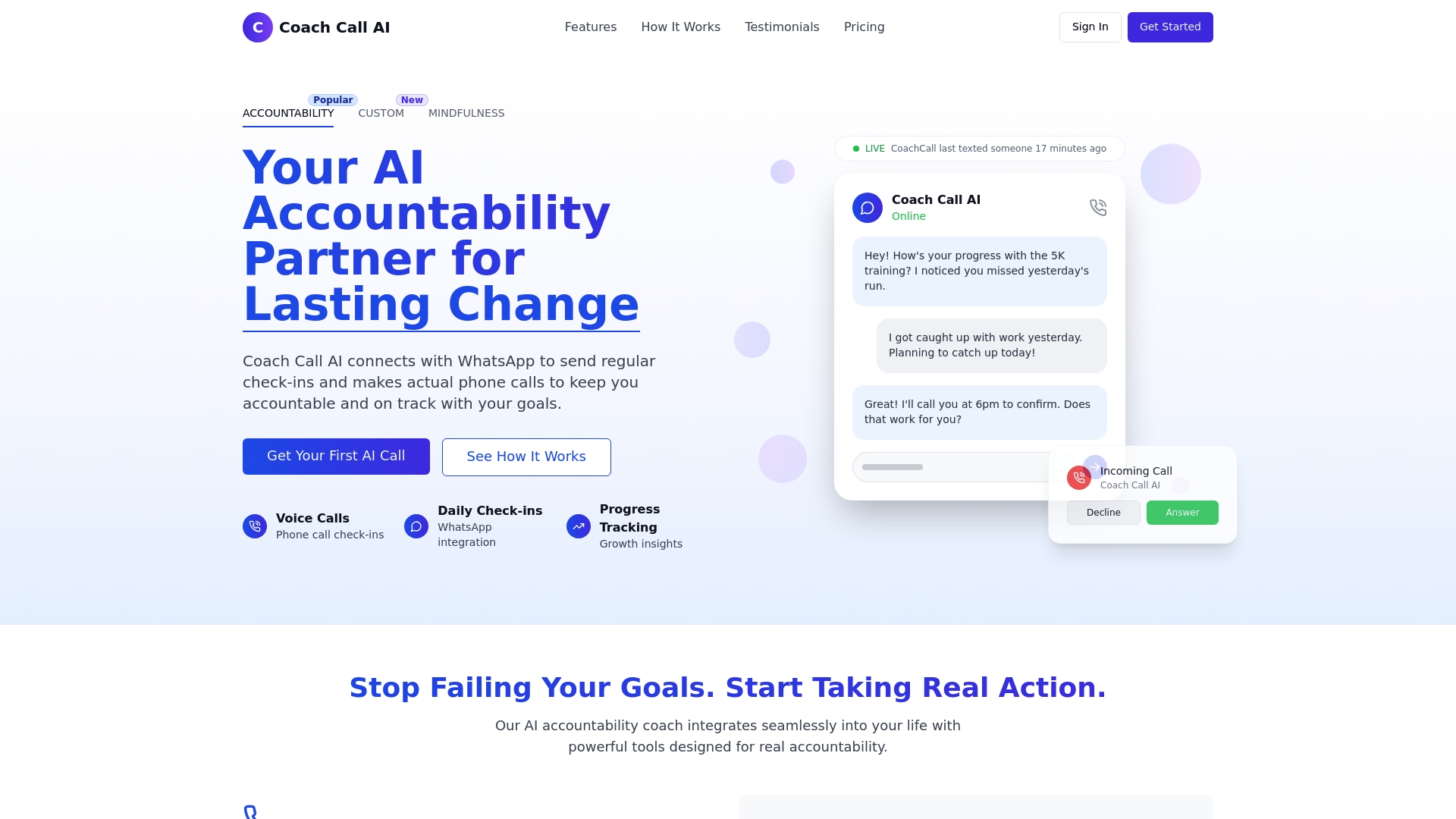
Coach Call AI delivers accountability through phone calls and WhatsApp integration, meeting you where you already communicate. The platform combines the data-driven insights discussed throughout this guide with natural conversation that feels genuinely supportive.
Benefits of choosing Coach Call AI:
- Sustained motivation through scheduled voice calls and real-time messaging
- Personalized feedback based on your unique behavioral and progress data
- Convenient communication via familiar WhatsApp interface
- Adaptive coaching that evolves with your changing needs and circumstances
Explore how the Coach Call AI accountability platform can transform your goal achievement through intelligent data use and consistent support designed around your lifestyle.
FAQ
What types of personal data do AI coaching tools collect?
AI coaching platforms gather biometric information like heart rate and sleep patterns, behavioral data including activity logs and task completion, and engagement metrics such as app usage frequency. Collection scope varies by platform and your permission settings. You control which data types to share based on your coaching goals and privacy preferences.
How does AI coaching protect my privacy and data?
Ethical AI coaches implement strict consent frameworks and transparency standards guided by organizations like the International Coaching Federation. You maintain control over what data you share, how long platforms retain it, and can delete information anytime. Reputable platforms use encryption and secure servers to protect your data from unauthorized access.
Can AI coaching replace human coaches entirely?
AI coaching complements rather than replaces human support by providing continuous data insights and personalized feedback between sessions. Human coaches offer empathy, complex judgment, and nuanced understanding that AI cannot fully replicate. The most effective approach often combines AI's consistent data analysis with human coaching for deeper emotional and strategic guidance.
How can I best use data insights from AI coaching to stay accountable?
Regularly review weekly insights to understand behavioral patterns, set specific measurable goals based on baseline data, and actively implement AI recommendations for trial periods. Balance data sharing with privacy comfort by using granular permission controls. Engage consistently with feedback and treat AI as a collaborative partner rather than passive tool for maximum accountability benefits.