
Staying accountable to personal goals feels impossible when life gets busy. Between work deadlines, family commitments, and endless distractions, even the most motivated professionals and students struggle to maintain focus on self improvement. Traditional accountability partners often flake, and willpower alone rarely sustains long term progress. A structured coaching workflow offers a clear, repeatable system to keep you on track, combining proven phases like assessment, goal setting, and regular reviews with AI driven support that's available 24/7. This guide walks you through building and executing a coaching workflow that fits your schedule, reduces overwhelm, and delivers measurable results in productivity, well-being, and personal growth.
Table of Contents
- Key takeaways
- Understanding structured coaching workflows
- Preparing your structured coaching workflow: tools and setup
- Executing the workflow: step-by-step coaching process
- Common challenges and troubleshooting in structured coaching workflows
- Elevate your personal growth with AI powered accountability
- Frequently asked questions
Key Takeaways
| Point | Details |
|---|---|
| Structured coaching phases | A repeatable five step workflow guides progress from assessment to review, providing clarity and momentum. |
| Always on AI support | AI coaching provides 24/7 accountability by automating reminders, tracking patterns, and adapting guidance to progress. |
| Hybrid AI human coaching | Combining scalable AI with human empathy delivers better results than AI or humans alone. |
| Reduce cognitive load | Structured workflows minimize decision overload by providing a clear sequence of tasks. |
Understanding structured coaching workflows
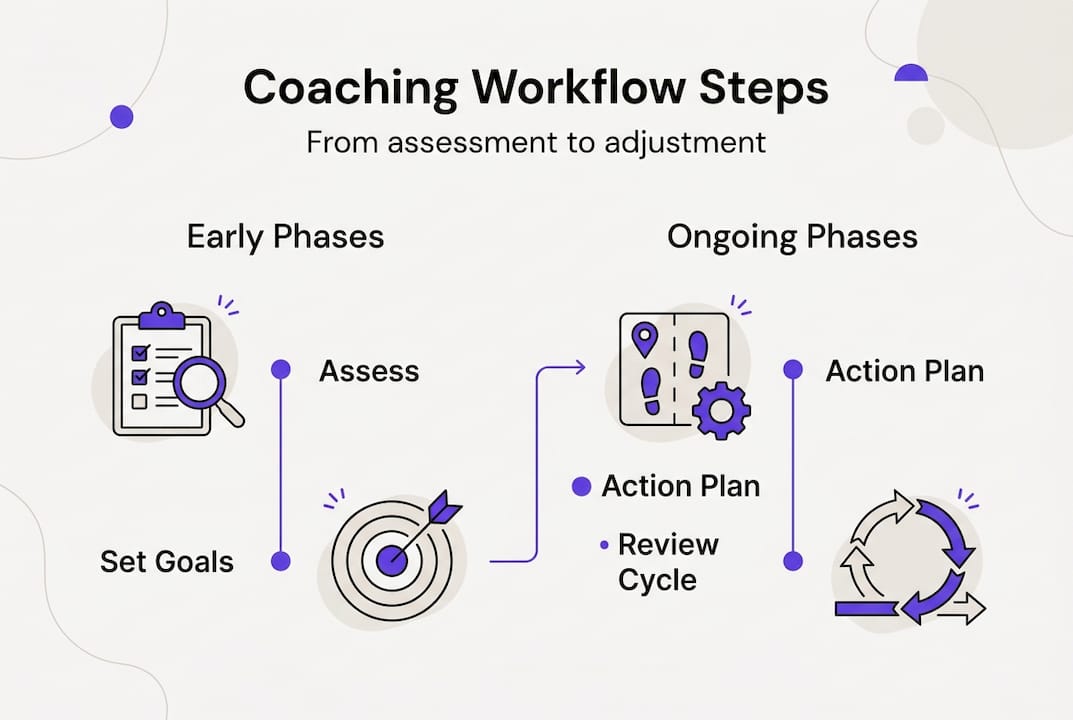
A structured coaching workflow is a systematic, phased approach to personal development that breaks down growth into manageable, repeatable steps. Instead of vague intentions like "get healthier" or "be more productive," these frameworks guide you through specific stages that build on each other, creating momentum and clarity. Structured coaching workflows typically follow phased models including assessment, goal setting, action planning, implementation, review, and completion, as demonstrated in 12 week business frameworks and performance coaching methodologies.
The typical workflow unfolds in five core phases:
- Assessment: Identify current state, strengths, challenges, and growth opportunities through self reflection or guided questions
- Goal setting: Define specific, measurable objectives aligned with personal values and desired outcomes
- Strategy development: Create actionable plans with timelines, milestones, and resource allocation
- Execution: Implement tasks consistently while tracking progress and maintaining accountability
- Review and adjustment: Reflect on results, celebrate wins, troubleshoot obstacles, and refine approach
Why does structure matter so much for personal growth? Research shows coaching improves performance by 24% and drives revenue growth of 23 to 30%, validating the effectiveness of systematic coaching dimensions. Structure eliminates the paralysis of choice, reduces cognitive load, and provides clear signals when you're drifting off course. Instead of constantly deciding what to work on next, you follow a proven sequence that keeps momentum alive.
For busy professionals and students, structured workflows solve the consistency problem. You don't need endless willpower when the system tells you exactly what to do and when. AI coaching tools amplify this benefit by automating reminders, tracking patterns, and adapting support based on your progress. The combination of human designed structure and AI powered execution creates a sustainable path to personal development that fits into packed schedules.
Pro Tip: Start with a single 12 week cycle focused on one major goal rather than trying to transform everything at once. Mastering the workflow with focused effort builds confidence and proves the system works before expanding to multiple growth areas.
Preparing your structured coaching workflow: tools and setup
Before diving into execution, you need the right foundation of tools, systems, and human control points to keep your workflow running smoothly. The preparation phase determines whether your coaching system becomes a sustainable habit or another abandoned New Year's resolution.
Essential tools fall into three categories:
- AI coaching platforms: Apps that provide 24/7 accountability, progress tracking, and personalized guidance
- Communication channels: WhatsApp integration, voice call systems, or messaging interfaces for regular check ins
- Progress visualization: Dashboards, journals, or tracking sheets that show momentum over time
AI coaching provides 24/7 accountability through platforms like Coach4Life and Groway, which are specifically designed for busy professionals and students who need flexible support. These tools capture context from every interaction, remembering your goals, challenges, and preferences to deliver increasingly personalized coaching over time.
The key to effective preparation is balancing automation with human oversight. Practical guides recommend repeatable workflows with human control points and constraints to prevent drift from your original intentions. AI handles the heavy lifting of daily reminders, progress tracking, and pattern recognition, while you maintain strategic control over goal direction and major decisions.
| Platform Type | Key Features | Best For |
|---|---|---|
| AI voice coaching | Scheduled calls, natural conversation, WhatsApp integration | Professionals needing hands free support |
| Text based AI coaches | 24/7 messaging, quick check ins, goal tracking | Students and multitaskers |
| Hybrid platforms | AI automation plus human coach access | Complex goals requiring nuanced guidance |
| Progress dashboards | Visual tracking, milestone celebrations, data export | Data driven individuals |
Your setup should include clear constraints to maintain focus. Define your coaching schedule upfront, such as daily 5 minute check ins, weekly 20 minute reviews, and monthly deep dives. Block these times in your calendar as non negotiable appointments. Set boundaries around which goals the AI can adjust versus which require your explicit approval. This structure prevents the system from becoming just another app you ignore.
Track development milestones by establishing baseline metrics before starting. If you're working on productivity, measure current task completion rates, focus time, and energy levels. For fitness goals, record starting weight, workout frequency, and endurance benchmarks. These numbers provide objective feedback that cuts through subjective feelings and keeps you honest about progress.

Pro Tip: Schedule your AI coaching check ins for transition moments in your day, like right after morning coffee or during your commute home. These natural breaks make it easier to build the habit without adding friction to your routine.
Executing the workflow: step-by-step coaching process
With your tools and setup ready, it's time to execute the structured coaching workflow. Each phase builds on the previous one, creating a systematic path from awareness to achievement. AI support enhances every step, but you remain the strategic decision maker.
Step 1: Initial assessment and identifying growth areas
Begin with honest self evaluation across key life dimensions. Performance coaching frameworks validate three critical areas: performance, well-being, and relationships. Use guided questions from your AI coach or journaling prompts to identify where you're thriving and where you're stuck. Don't rush this phase. Spending 2 to 3 hours on thorough assessment saves weeks of working on the wrong priorities.
Step 2: Setting SMART goals aligned with personal values
Transform assessment insights into specific, measurable, achievable, relevant, and time bound goals. Vague aspirations like "be healthier" become "exercise 4 times weekly for 30 minutes by March 31." Your AI coach can help refine goal language and check for realistic timelines based on your schedule and past patterns. Align each goal with your core values to maintain intrinsic motivation when external accountability fades.
Step 3: Developing strategic action plans with AI guidance
Break each goal into weekly milestones and daily actions. If your goal is launching a side project, your action plan might include researching competitors week one, building a prototype week two, and gathering feedback week three. AI excels at suggesting task sequences, estimating time requirements, and identifying potential obstacles before you hit them. This planning phase typically takes 1 to 2 hours per goal.
Step 4: Executing tasks with continuous AI and human accountability
This is where daily consistency matters most. Your AI coach sends reminders, celebrates completed tasks, and asks reflection questions to maintain engagement. Hybrid coaching models blend AI consistency with human nuance, delivering 30% better goal adherence by combining automated accountability with empathetic support during tough moments. Check in with your system every day, even if just for 2 minutes, to maintain the habit loop.
Step 5: Regular review, reflection, and adjustment cycles
Schedule weekly 15 minute reviews to assess progress, troubleshoot obstacles, and adjust plans based on real world feedback. Monthly deep dives of 45 to 60 minutes examine larger patterns, celebrate major wins, and reset goals if priorities shift. AI captures all your progress data, making these reviews faster and more insightful than manual journaling alone. The review phase closes the learning loop, turning experience into wisdom.
| Coaching Approach | Strengths | Limitations | Best Use Case |
|---|---|---|---|
| AI only | 24/7 availability, consistent messaging, scalable, affordable | Limited emotional depth, struggles with complex nuance | Daily accountability, habit tracking, routine goals |
| Human only | Deep empathy, creative problem solving, relationship building | Scheduling hassles, higher cost, availability gaps | Complex personal issues, career transitions, deep trauma |
| Hybrid AI and human | Combines AI consistency with human insight, fills availability gaps | Requires coordination between systems | Ambitious multi month goals, personal growth with accountability |
AI voice coaching for busy professionals offers particular advantages during execution by allowing hands free check ins during commutes, walks, or household tasks. Voice interactions feel more personal than text, increasing engagement and making accountability feel like a supportive conversation rather than a chore.
Pro Tip: Use your AI coach to capture context immediately after important events, wins, or setbacks. These real time notes create a rich personal database that enables increasingly tailored guidance as your coaching relationship deepens over weeks and months.
Common challenges and troubleshooting in structured coaching workflows
Even well designed coaching workflows hit obstacles. Recognizing common challenges early and having troubleshooting strategies ready keeps your system resilient when life gets messy.
Challenge 1: Maintaining structure during crisis or heavy workload
When urgent demands explode, structured coaching often gets abandoned first. Business coaching frameworks acknowledge that edge cases like sudden business demands, high cognitive load, and crisis situations require adaptable coaching styles while maintaining core structure. The solution is scaling down, not giving up. Reduce your daily check in from 10 minutes to 2 minutes. Shift from ambitious goals to maintenance mode. Your AI coach can adjust expectations automatically based on your stress signals.
Challenge 2: Cognitive overload from too many simultaneous goals
Trying to improve fitness, productivity, relationships, and finances simultaneously overwhelms your mental bandwidth. Phased workflows solve this by sequencing goals across quarters rather than tackling everything at once. Focus intensely on one or two areas per 12 week cycle, then rotate to different priorities. Structure reduces cognitive load by eliminating constant decision making about what deserves attention.
Challenge 3: Losing motivation when progress feels slow
Personal growth rarely follows a linear path. Plateaus, setbacks, and invisible progress periods test commitment. Combat this by tracking leading indicators, not just outcomes. If your goal is weight loss, celebrate consistency in workouts and meal prep, not just scale numbers. AI coaching excels at recognizing and celebrating these process wins that human coaches might miss.
Challenge 4: Over relying on AI without human intuition
AI provides consistency and data analysis, but it lacks the creative problem solving and emotional intelligence of human coaches. When you're truly stuck or facing complex interpersonal challenges, boost accountability through hybrid approaches that combine AI's daily support with periodic human coaching sessions. This blend leverages each system's strengths while covering their limitations.
Practical troubleshooting steps when your workflow stalls:
- Audit your schedule: Are coaching check ins actually blocked in your calendar or just good intentions?
- Simplify goals: Cut your target list in half and go deeper on fewer priorities
- Adjust timing: Move check ins to different times of day when energy and focus are higher
- Seek external input: Share your progress with a friend or human coach for fresh perspective
- Celebrate small wins: Recognition fuels motivation more than criticism drives improvement
"Structure doesn't limit creativity or flexibility. It frees mental capacity by handling routine decisions automatically, leaving your best thinking for strategic choices and creative problem solving."
Pro Tip: Schedule buffer time of 20 to 30% beyond your estimated task duration to handle unexpected disruptions without derailing your entire workflow. This breathing room prevents the cascade effect where one missed task topples your whole week.
Elevate your personal growth with AI powered accountability
You've learned how structured coaching workflows transform vague intentions into systematic progress through proven phases of assessment, planning, execution, and review. The combination of clear structure with AI driven accountability solves the consistency problem that defeats most personal growth efforts.
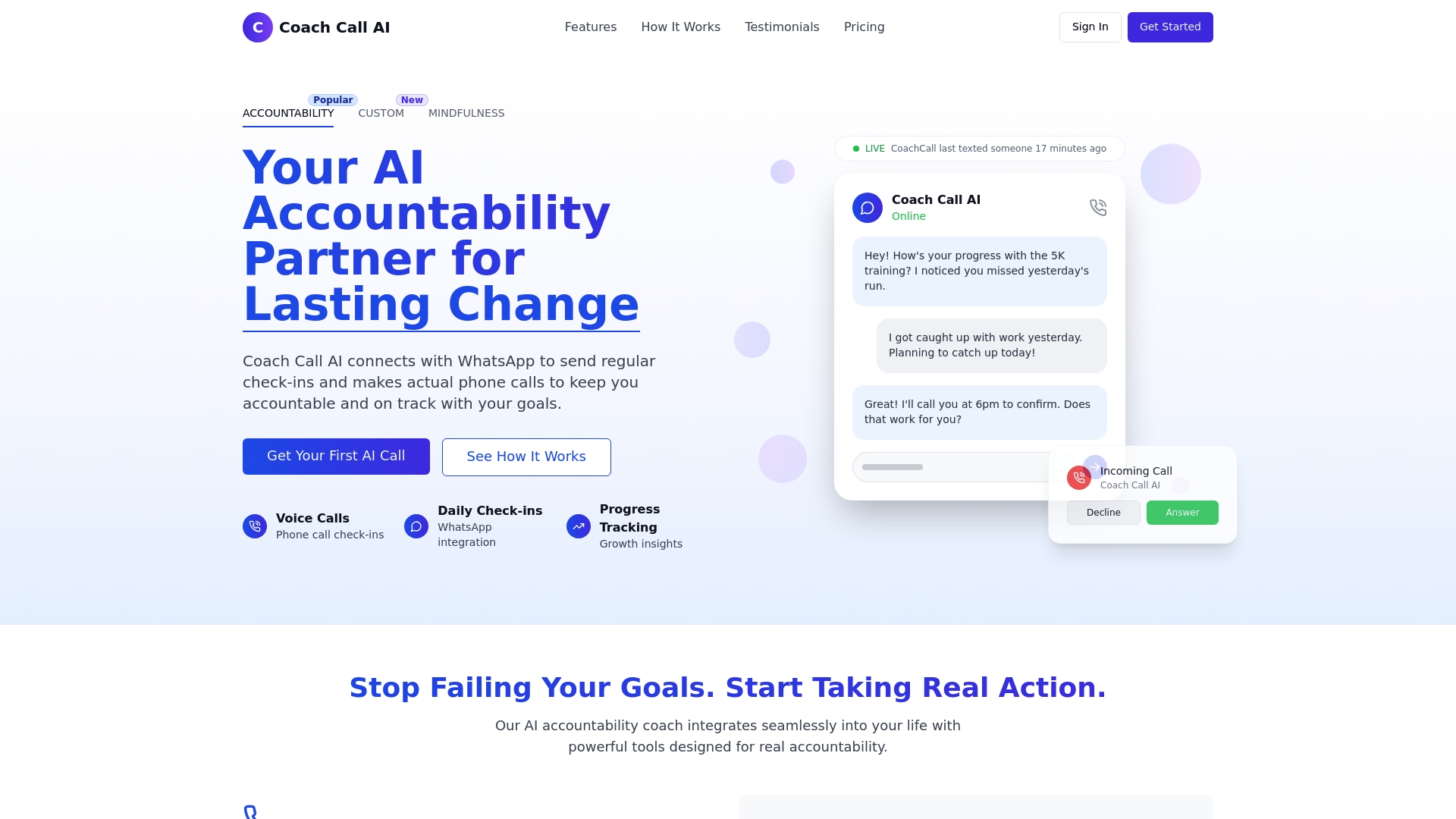
Coach Call AI brings this workflow to life through WhatsApp integration and scheduled voice calls that fit seamlessly into your busy schedule. Whether you're a professional juggling work deadlines or a student balancing classes and personal goals, our AI coaching platform provides 24/7 support that remembers your context, celebrates your wins, and keeps you accountable when motivation fades. Discover how AI coaching personas can be tailored to your unique growth style, from directive task management to supportive emotional coaching.
Our platform tracks your development milestones automatically, visualizes progress over time, and adjusts support based on your patterns and preferences. Stop relying on unreliable accountability partners or unsustainable willpower alone. Explore self improvement strategies that combine human wisdom with AI consistency to achieve goals you've been putting off for years. Start your free trial today and experience how structured coaching workflows accelerate personal growth without adding complexity to your already full life.
Frequently asked questions
What is a structured coaching workflow?
A structured coaching workflow is a systematic, phased approach to personal development that guides you through assessment, goal setting, action planning, execution, and regular review cycles. This repeatable framework eliminates decision fatigue and maintains momentum toward your growth objectives.
How can AI enhance my coaching experience?
AI coaching provides 24/7 availability, consistent accountability, and context retention that human coaches can't match at scale. It tracks patterns across your progress data, sends timely reminders, and personalizes guidance based on your unique preferences and schedule, making professional level coaching accessible anytime.
Are hybrid coaching models effective?
Yes, hybrid models combining AI automation with human insight deliver 30% better goal adherence than either approach alone. AI handles daily accountability and progress tracking while human coaches provide nuanced guidance for complex challenges, creating a comprehensive support system that covers both consistency and depth.
What should I do if my coaching plan feels overwhelming?
Scale down immediately rather than abandoning the system entirely. Reduce check in frequency, cut your goal list in half, and focus on maintenance rather than aggressive growth. Structure should reduce overwhelm, not create it, so adjust your workflow to match your current capacity and energy levels.
How do I choose the best AI coaching style for my goals?
Match your coaching persona to your personality and goal type. Directive styles work well for task oriented productivity goals, while supportive styles suit emotional well-being and relationship growth. Experiment with different personas for 2 to 3 weeks to find what maintains your engagement and delivers results.