
Staying consistent with personal goals feels impossible when your calendar overflows with meetings, deadlines, and endless to-do lists. Traditional accountability partners often cancel or lose interest, leaving you alone in your fitness, productivity, or wellness journey. AI voice assistants now offer a practical solution, delivering personalized coaching through natural speech interactions that fit seamlessly into your hectic routine, transforming how busy professionals maintain progress toward meaningful goals.
Table of Contents
- Introduction To AI Voice Assistants In Coaching
- How Voice Assistants Enhance Coaching Effectiveness
- Common Misconceptions About AI Voice Coaching
- Comparing AI Voice Coaching To Traditional Human Coaching
- Practical Integration Of Voice Assistants For Busy Professionals
- Privacy, Ethics, And User Trust In AI Voice Coaching
- Future Trends And Enhancements In AI Voice Coaching
- Discover Coach Call AI: Your Voice-Based Accountability Partner
- Frequently Asked Questions About AI Voice Coaching
Key takeaways
| Point | Details |
|---|---|
| AI voice coaching dramatically improves adherence | Voice-activated AI assistants increase coaching consistency by 72% during daily routines for busy adults. |
| Natural language personalization drives engagement | Empathetic language models boost retention by 25% compared to generic automated messages. |
| Privacy transparency builds user trust | Clear data policies increase user willingness to engage with AI coaching by 45%. |
| Messaging app integration enables convenient use | Most professionals prefer AI coaching through platforms like WhatsApp for hands-free daily accountability. |
| AI matches human coaching effectiveness | Research shows AI voice coaching delivers comparable or superior goal adherence outcomes. |
Introduction to AI voice assistants in coaching
AI voice assistants are software applications that enable natural speech interaction and task automation through advanced language processing. These systems recognize spoken commands, interpret context, and respond conversationally without requiring typed input or screen interaction. The technology has evolved rapidly from simple command execution to sophisticated coaching capabilities.
The coaching industry has witnessed explosive growth in AI voice technology applications. Busy professionals face three primary coaching needs: consistent accountability to maintain momentum, personalized motivation tailored to individual circumstances, and accessibility that works around unpredictable schedules. Voice assistants address each need simultaneously through always-available, conversational support.
Real-world applications span diverse personal development areas. Fitness enthusiasts use voice check-ins to log workouts and receive form corrections. Productivity seekers get verbal reminders about priorities and time management strategies. Mental wellness users engage in guided breathing exercises or cognitive reframing conversations. An AI accountability partner can deliver all these interventions through a single platform.
Key use cases include:
- Morning motivation routines with personalized affirmations
- Mid-day productivity audits through brief voice conversations
- Evening reflection prompts to track mental well-being
- Weekend goal-setting sessions with progress reviews
- Milestone celebrations that reinforce positive behaviors
The hands-free nature of voice interaction removes friction from coaching engagement. You can participate while driving, cooking, exercising, or performing other activities that make typing impractical. This accessibility factor proves especially valuable for professionals juggling multiple responsibilities throughout their day.
How voice assistants enhance coaching effectiveness
Regularly scheduled voice check-ins create reliable accountability routines that humans struggle to maintain consistently. Unlike friends or colleagues who might forget or reschedule, AI systems execute planned interactions with perfect reliability. This consistency builds trust and establishes habits faster than sporadic human contact.
Natural language processing enables real-time personalized responses based on your specific situation, mood, and progress patterns. The system adapts its tone, suggestions, and encouragement level to match what works best for you. Research confirms that 72% of users reported increased coaching consistency when using voice-activated AI assistants during daily routines.
Automated milestone celebrations reinforce progress and sustain motivation through difficult periods. The system recognizes achievements without you needing to self-report or wait for external validation. Immediate positive feedback strengthens the connection between effort and reward, making goal pursuit more satisfying.

Hands-free voice interactions reduce cognitive load compared to app interfaces requiring visual attention and manual input. Speaking feels more natural than typing for many communication needs. This ease of use increases engagement frequency, especially during moments when pulling out your phone would be disruptive or unsafe.
Key effectiveness mechanisms:
- Voice tone analysis detecting stress or enthusiasm levels
- Contextual memory recalling previous conversations and commitments
- Adaptive questioning that explores barriers without judgment
- Real-time strategy suggestions tailored to current challenges
- Progress visualization through verbal summaries of trends
Pro Tip: Schedule your AI voice coaching check-ins immediately after existing habits like morning coffee or evening meals to ensure consistent participation without requiring new willpower.
The combination of reliability, personalization, and convenience creates a coaching experience that many users find more effective than traditional human arrangements. The technology eliminates common friction points while delivering core accountability and motivation benefits that drive goal achievement.
Common misconceptions about AI voice coaching
Many people assume AI lacks the empathy necessary for effective coaching relationships. Modern language models trained on emotional communication patterns actually demonstrate impressive capacity for supportive, understanding responses. Studies show that AI voice coaches using empathetic language increase retention by 25% compared to generic automated messages.
Another widespread belief suggests AI coaching must be inferior to human coaching in achieving results. Research comparing outcomes reveals AI voice coaching matches or exceeds human coaching effectiveness for goal adherence. The key advantage lies in consistency rather than superiority, the AI never has an off day or loses interest in your progress.
Privacy concerns represent a legitimate consideration that technology companies must address transparently. When platforms implement clear data policies and user controls, transparent privacy practices boost willingness to engage by 45%. Users feel comfortable sharing personal information when they understand exactly how systems protect and use their data.
Some professionals worry that voice coaching requires significant time investment. The reality proves opposite, brief two to three minute voice exchanges provide sufficient accountability without disrupting workflow. The hands-free nature means you can participate while commuting, exercising, or doing household tasks.
Common myths include:
- AI cannot understand nuanced emotional states or complex personal situations
- Voice coaching only works for simple, straightforward goals like step counting
- Privacy risks outweigh potential benefits of AI coaching engagement
- Effective coaching requires lengthy sessions that busy people cannot accommodate
- AI recommendations lack the wisdom and judgment of experienced human coaches
The technology continues evolving to address legitimate concerns while debunking unfounded fears. Understanding the actual capabilities and limitations helps potential users make informed decisions about incorporating voice coaching into their self-improvement strategies.
Comparing AI voice coaching to traditional human coaching
AI coaching offers 24/7 availability that no human coach can match practically or affordably. You can request support at 2am during an anxiety spike or grab a quick motivation boost between meetings. This round-the-clock access prevents gaps in accountability that often derail progress.
Human coaches provide deeper emotional empathy rooted in shared human experience and intuition. They recognize subtle cues, adapt to unspoken needs, and offer wisdom from their own journeys. This irreplaceable element makes human coaching valuable for complex emotional work or major life transitions.
AI voice coaching delivers consistent, scheduled accountability with personalized natural language processing. The system never judges, never gets frustrated, and maintains perfect objectivity about your patterns. Many users find this non-judgmental consistency psychologically safer than human interaction.
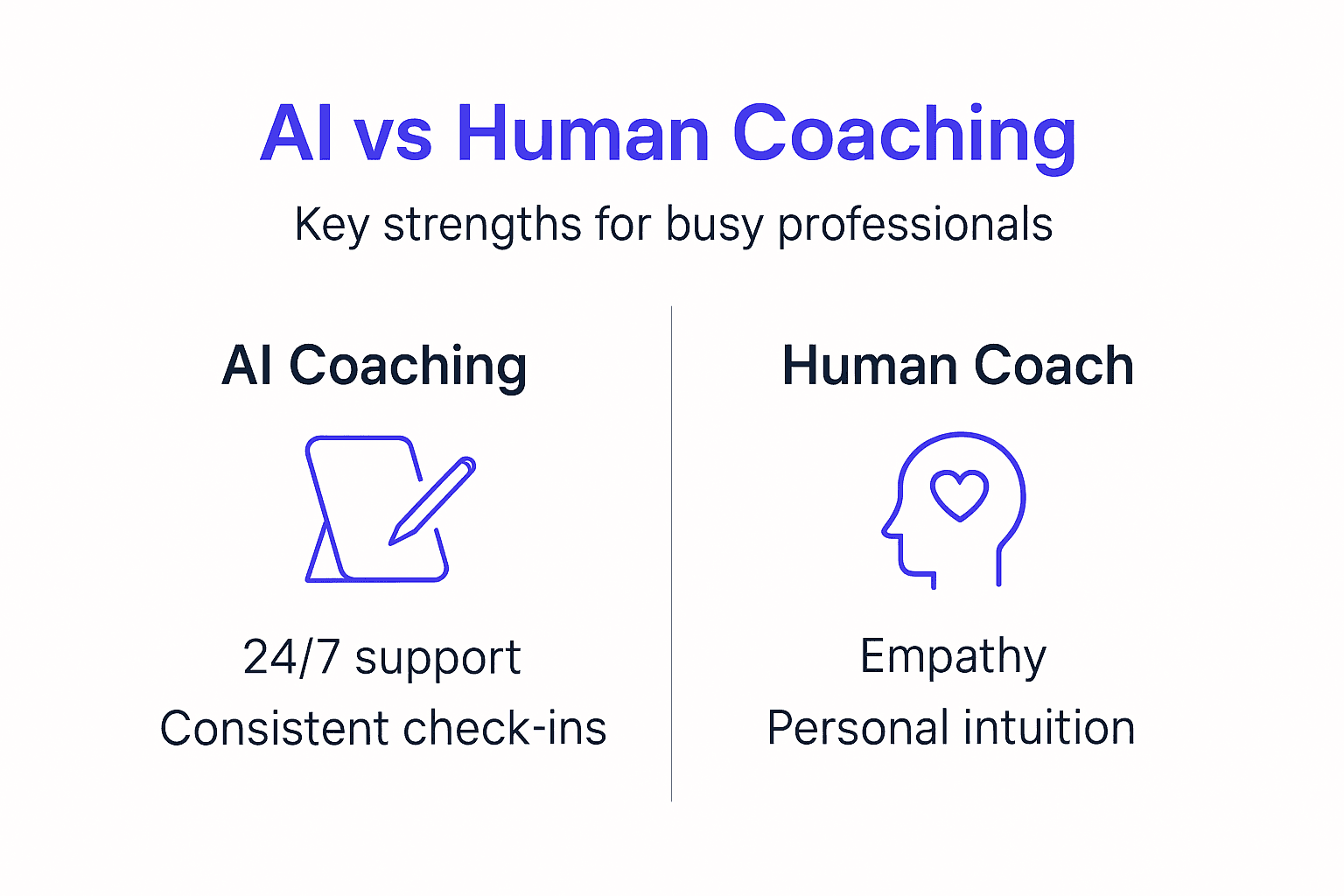
Cost and scheduling limitations make human coaching impractical for many busy professionals. Weekly 60-minute sessions cost hundreds of dollars monthly and require advance booking. AI coaching operates at fraction of the cost with instant availability.
| Feature | AI Voice Coaching | Traditional Human Coaching |
|---|---|---|
| Availability | 24/7 instant access | Scheduled appointments only |
| Cost | Low monthly subscription | $100-$300+ per session |
| Consistency | Perfect reliability | Subject to cancellations |
| Emotional depth | Empathetic language models | Deep human empathy |
| Scalability | Unlimited interactions | Limited by coach capacity |
| Personalization | Data-driven adaptation | Intuitive human judgment |
Key comparison points:
- AI excels at routine accountability and habit formation
- Humans excel at complex emotional processing and major decisions
- AI provides consistent baseline support between human sessions
- Humans offer irreplaceable connection for deep therapeutic work
- Hybrid approaches combining both deliver optimal results
Pro Tip: Use AI voice coaching for daily accountability and habit tracking while reserving monthly human coaching sessions for strategic planning and emotional processing that requires deeper empathy.
Neither option completely replaces the other for all situations. Personal coaching insights suggest the ideal approach often combines AI consistency with periodic human guidance, leveraging each method's unique strengths.
Practical integration of voice assistants for busy professionals
Successful integration starts with setting clear, measurable goals within your AI platform. Define specific targets like exercising four times weekly, completing three priority tasks daily, or practicing mindfulness for ten minutes each morning. Precision enables the system to track progress accurately and provide relevant feedback.
Schedule regular voice check-ins at times that align with your natural routines and energy patterns. Morning check-ins work well for setting daily intentions. Mid-afternoon sessions help reset focus during energy dips. Evening reviews allow reflection on accomplishments and challenges.
Engaging actively with personalized messages and milestone feedback strengthens the coaching relationship. Respond honestly to prompts, share obstacles you face, and acknowledge celebrations the system offers. This interaction teaches the AI your preferences and communication style.
Most professionals find that 72% prefer AI coaching integrated with messaging apps like WhatsApp for daily accountability. WhatsApp voice coaching eliminates the need to learn new interfaces or remember to open separate apps. The coaching comes to you through a platform you already use constantly.
Reviewing AI-generated progress insights helps you adjust plans dynamically based on what actually works. Look for patterns in successful days versus struggles. Notice which strategies boost motivation and which fall flat. Use this self-knowledge to refine your approach continuously.
Integration steps:
- Define three specific goals with measurable success criteria
- Choose check-in times that fit naturally into existing daily routines
- Enable voice features and test audio quality in your typical environments
- Start with brief two-minute interactions to build the habit comfortably
- Gradually increase engagement depth as the system learns your patterns
- Review weekly progress summaries to identify trends and adjust strategies
- Celebrate milestones the system highlights to reinforce positive momentum
The key lies in starting small and building gradually rather than attempting dramatic overnight transformation. Voice coaching works best as a consistent companion supporting incremental progress toward meaningful goals over weeks and months.
Privacy, ethics, and user trust in AI voice coaching
Privacy transparency significantly boosts user willingness to engage with voice coaching platforms. When companies clearly explain what data they collect, how they use it, and how long they retain it, users feel confident participating honestly. Vague or hidden policies create justified skepticism that reduces engagement quality.
Ethical data use involves minimal data retention practices and clear user controls over personal information. Platforms should collect only information necessary for coaching effectiveness, not harvest everything possible for unclear future purposes. Users deserve simple options to view, export, or delete their data anytime.
Voice data requires especially careful security measures since recordings contain sensitive personal information and behavioral patterns. Encryption during transmission and storage prevents unauthorized access. Regular security audits and breach response plans demonstrate serious commitment to protection.
Users must provide informed consent before any data collection begins. This means understanding in plain language what they agree to, not buried in dense legal text. Consent should be specific to each use case rather than blanket permission for undefined purposes.
Ethical considerations include:
- Avoiding manipulative techniques that exploit psychological vulnerabilities
- Maintaining clear boundaries between helpful coaching and intrusive surveillance
- Respecting user autonomy in goal selection rather than imposing external agendas
- Acknowledging AI limitations and recommending human help when appropriate
- Ensuring diverse training data prevents biased or discriminatory responses
Building user trust requires ongoing commitment to transparent communication about privacy practices and security measures. Platforms that prioritize user control and ethical data handling will earn long-term loyalty from professionals seeking reliable accountability support without compromising personal information security.
Future trends and enhancements in AI voice coaching
Advances in empathetic AI will deepen emotional engagement through more nuanced tone recognition and contextually appropriate responses. Future systems will detect subtle vocal stress markers and adjust their approach in real-time. This emotional intelligence will create coaching relationships that feel genuinely supportive rather than mechanically scripted.
Customizable coach personas will allow users to select coaching styles matching their preferences and personalities. Some people respond best to direct, no-nonsense accountability. Others need gentle encouragement and abundant positive reinforcement. Persona options enable personalization beyond content to include fundamental interaction style.
Integration with wearables and other data sources will create holistic coaching feedback based on comprehensive life patterns. Sleep quality data, heart rate variability, location patterns, and calendar commitments will inform more intelligent, contextually aware suggestions. The system will understand that poor sleep impacted your workout performance or that a stressful meeting triggered unhealthy coping behaviors.
Ongoing natural language processing improvements will make interactions feel increasingly natural and adaptive. Future voice assistants will handle complex, multi-turn conversations with better context retention. They will understand implied meanings, cultural references, and individual communication quirks that currently challenge AI systems.
Emerging capabilities include:
- Proactive intervention detecting concerning patterns before users request help
- Multi-language support enabling coaching in users' preferred languages
- Group coaching features connecting users with similar goals for peer support
- Integration with professional therapy for seamless referrals when needed
- Predictive analytics identifying high-risk moments for goal abandonment
The trajectory points toward AI voice coaching becoming indistinguishable from human interaction in routine accountability contexts while developing capabilities humans cannot match, like processing vast personal data to identify non-obvious patterns affecting goal achievement.
Discover coach call ai: your voice-based accountability partner
Ready to experience AI voice coaching that actually fits your life? Coach Call AI offers scheduled voice calls and WhatsApp integration designed specifically for busy professionals seeking consistent accountability without scheduling hassles or expensive fees.
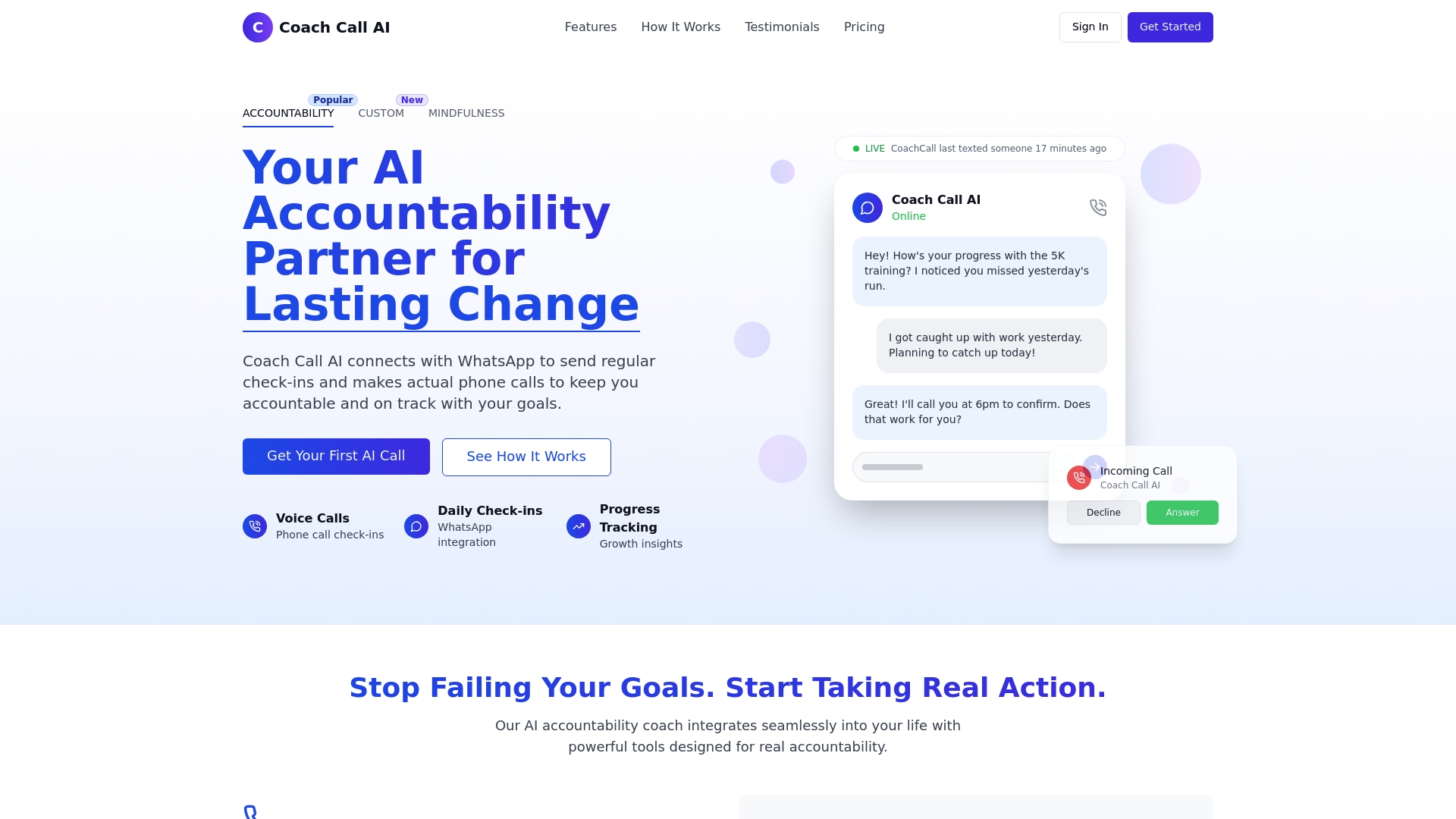
The platform delivers personalized coaching interactions tailored to your specific goals, whether you focus on fitness, productivity, mental well-being, or multiple areas simultaneously. Natural language conversations adapt to your communication style and preferences. 24/7 availability means support arrives exactly when you need it, not just during scheduled appointment windows.
Explore how Coach Call AI transforms goal achievement through reliable, intelligent voice coaching that never cancels, never judges, and always celebrates your progress.
Frequently asked questions about AI voice coaching
What kinds of goals can AI voice coaching support?
AI voice coaching effectively supports fitness goals like consistent exercise and nutrition tracking, productivity objectives including time management and task completion, mental wellness practices such as meditation and stress reduction, and personal development aims like learning new skills or building better habits. The technology works best for goals requiring regular accountability and incremental progress rather than one-time achievements.
How is my privacy protected with voice AI coaches?
Reputable platforms encrypt voice data during transmission and storage, implement strict access controls limiting who can view your information, and provide clear privacy policies explaining data usage. Users should verify that platforms offer data export and deletion options, avoid selling information to third parties, and comply with privacy regulations. Reading the privacy policy before sharing sensitive information remains essential.
Can voice assistants really motivate better than humans?
Voice assistants provide more consistent accountability since they never miss scheduled check-ins or lose interest in your progress. However, humans offer deeper empathy and wisdom from lived experience that AI cannot fully replicate. Most research suggests AI excels at routine motivation and habit formation while humans better handle complex emotional situations requiring nuanced understanding and judgment.
Is it difficult to integrate voice coaching into a busy schedule?
Voice coaching integrates easily because interactions take only two to three minutes and work hands-free during existing activities like commuting, exercising, or meal preparation. You do not need to carve out separate appointment blocks or sit at a computer. The convenience factor makes voice coaching more accessible than traditional coaching for time-constrained professionals.
Do I still need occasional human coaching alongside AI?
Many people benefit from combining AI voice coaching for daily accountability with periodic human coaching for strategic planning and deeper emotional work. AI handles routine check-ins and habit tracking efficiently while human coaches provide perspective on major decisions, process complex feelings, and offer wisdom AI cannot match. The hybrid approach leverages each method's strengths for optimal results.