
You set goals with enthusiasm, promising yourself this time will be different. A week passes, then two, and somehow that commitment fades into the background noise of daily life. Sound familiar? The gap between intention and action isn't about willpower alone. It's about structure, accountability, and a proven process that keeps you moving forward even when motivation wanes. This guide reveals how to transform sporadic efforts into consistent progress through accountability-driven methods, strategic frameworks, and realistic planning that actually works for busy professionals and students seeking meaningful personal growth.
Table of Contents
- Prepare Your Self-Improvement Journey: Essentials And Mindset
- Execute Your Self-Improvement Plan With Accountability Step-By-Step
- Troubleshoot Common Pitfalls And Sustain Motivation
- Verify Your Results And Refine Your Process For Continuous Growth
- Discover AI-Powered Accountability To Supercharge Your Self-Improvement
Key takeaways
| Point | Details |
|---|---|
| Short cycles drive results | 12-week goal periods create urgency and maintain focus better than annual plans |
| Challenging goals boost performance | Specific and challenging goals consistently drive higher achievement than vague intentions |
| Accountability increases success | External support and regular check-ins raise goal achievement by 40% |
| Structured frameworks guide action | Models like GROW provide clear planning steps and decision points |
| Resilience sustains growth | Adaptability and emotional regulation help you navigate setbacks and maintain momentum |
Prepare your self-improvement journey: essentials and mindset
Before diving into action, you need a solid foundation. Success in personal development doesn't happen by accident. It requires clear direction, the right mental approach, and practical frameworks that turn abstract desires into concrete plans.
Start with goal clarity. Vague aspirations like "get healthier" or "be more productive" lack the specificity needed to drive action. Specific and challenging goals consistently drive higher performance because they give your brain a clear target. Instead of "exercise more," commit to "complete three 30-minute strength sessions weekly." The difference matters.
The 12-week year framework compresses annual planning into quarterly cycles. This approach creates urgency that yearly goals never achieve. When December feels far away, it's easy to procrastinate. When you're working in 12-week sprints, every week counts. You'll review progress more frequently, adjust faster, and maintain momentum that traditional annual planning can't match.
The GROW model offers a structured coaching framework for turning goals into action plans. It breaks down into four stages: Goal (what you want), Reality (where you are now), Options (possible paths forward), and Will (committed actions). This simple structure prevents the overwhelm that derails many self-improvement attempts. You're not just dreaming about change, you're mapping the route.
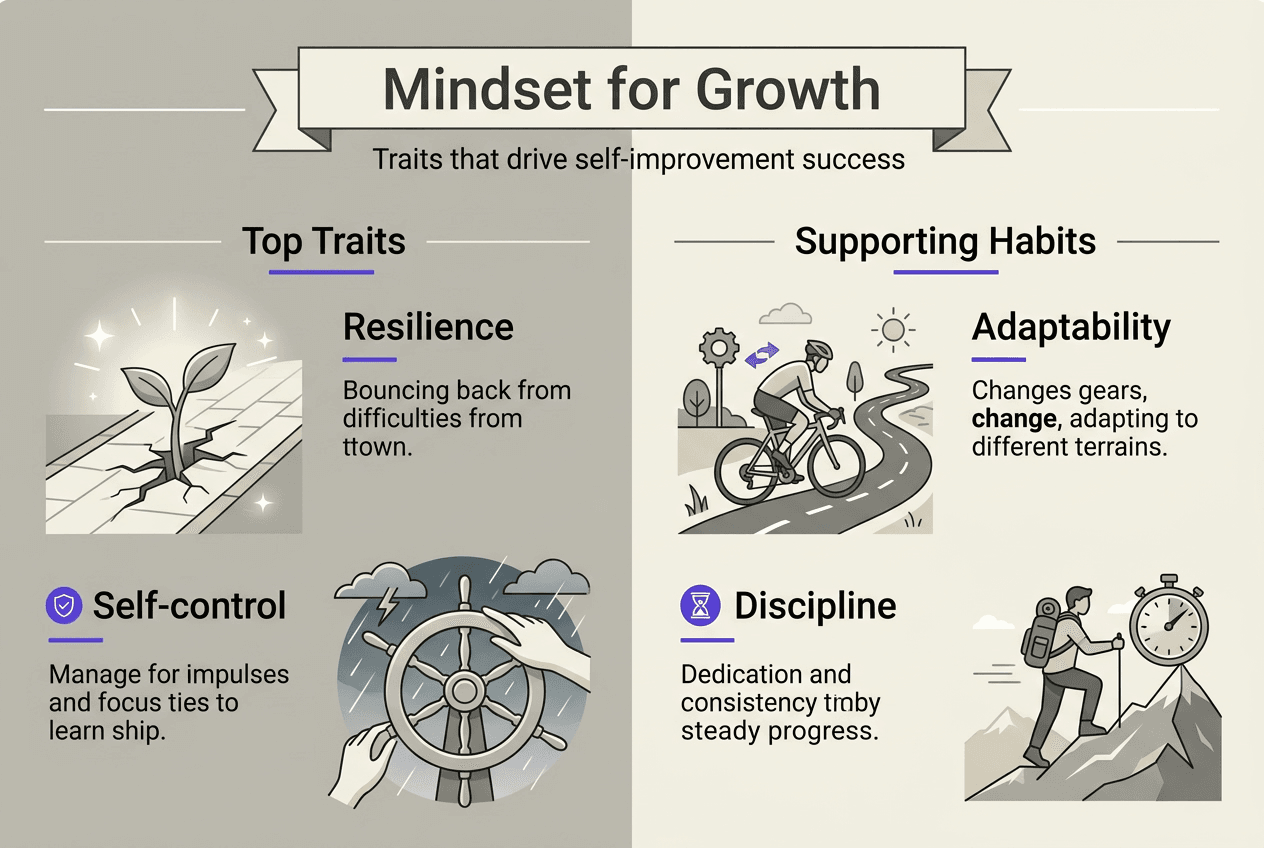
Your mindset shapes everything. Research shows that high self-control and resilience predict better goal pursuit and outcomes. Cultivate these traits by starting small, celebrating progress, and viewing setbacks as data rather than failures. The person who bounces back from a missed workout is more likely to succeed than the one who spirals into self-criticism.
Pro Tip: Write your goal on paper and place it somewhere you'll see daily. Physical reminders activate different neural pathways than digital notes, making commitment more tangible and harder to ignore.
Here's what you need before starting:
- Realistic, specific goals with measurable outcomes
- Commitment to regular review and adjustment
- A support system or accountability mechanism
- Basic tracking tools (app, journal, or spreadsheet)
- Willingness to learn from both success and failure
With these essentials in place, you're ready to move from preparation to execution. The self-improvement strategies that work best combine clear goals with consistent accountability, creating a system that supports you even when internal motivation fluctuates. Understanding how to achieve personal goals requires this foundation before any tactical steps.
Execute your self-improvement plan with accountability step-by-step
Execution separates dreamers from achievers. You've prepared your mindset and defined your goals. Now it's time to build the daily habits and accountability structures that turn plans into reality.
Follow this numbered sequence for consistent progress:
-
Break your 12-week goal into weekly targets. If you're aiming to read 12 books in 12 weeks, that's one book per week. This granularity makes progress visible and adjustments immediate.
-
Schedule weekly GROW sessions with yourself or an accountability partner. Set aside 20 minutes every Sunday to review your Goal, assess your Reality, explore Options for the coming week, and commit to specific Will actions.
-
Establish daily check-ins. A two-minute morning review of your top three priorities and an evening reflection on what you accomplished creates bookends that keep you aligned.
-
Track everything relevant to your goal. Numbers don't lie. Whether it's workout completion, pages read, or tasks finished, data reveals patterns you'll miss through memory alone.
-
Share progress externally. Accountability transforms clarity into action because knowing someone will ask about your progress creates healthy pressure.
External accountability amplifies results dramatically. Studies confirm that goal setting combined with accountability increases goal attainment by 40%. This isn't about judgment. It's about creating conditions where following through becomes easier than backing out.

You have several accountability options. Traditional accountability partners work when both people stay committed, but human relationships can falter. AI coaching tools offer consistent check-ins without scheduling conflicts or emotional baggage. Tracking apps provide data visualization but lack the conversational element that helps you process challenges. Choose based on what you'll actually use, not what sounds impressive.
Pro Tip: Schedule your accountability check-ins at the same time each week. Consistency in the review process creates consistency in the work itself, turning evaluation from a chore into a habit.
Here's how traditional annual goal setting compares to 12-week cycles:
| Approach | Urgency Level | Review Frequency | Adjustment Speed | Completion Rate |
|---|---|---|---|---|
| Annual Goals | Low (deadline feels distant) | Quarterly or less | Slow (long feedback loops) | 8-12% |
| 12-Week Cycles | High (constant awareness) | Weekly | Fast (immediate pivots) | 30-40% |
The data speaks clearly. Shorter cycles with frequent reviews create momentum that yearly planning can't match. You're not just working toward a goal, you're actively managing a living process that adapts to reality.
Boosting accountability becomes easier when you understand that it's not about willpower. It's about designing systems that make the right choice the easy choice. When data drives your accountability, you replace guesswork with evidence, making adjustments precise rather than random.
Troubleshoot common pitfalls and sustain motivation
Even with solid planning and accountability, obstacles emerge. Motivation fades, life gets chaotic, and that inner critic starts whispering reasons to quit. Knowing how to navigate these challenges separates temporary enthusiasm from lasting transformation.
The most common pitfalls include loss of motivation after initial excitement, feeling overwhelmed by the scope of change, and harsh self-criticism when you miss targets. Each requires a different response.
When motivation drops, remember that discipline matters more than feelings. Motivation is a spark that starts the fire, but systems and habits keep it burning. On days when you don't feel like it, do a scaled-down version. Can't manage a full workout? Do ten minutes. Can't write 1000 words? Write 100. Consistency beats intensity every time.
Overwhelm signals that you're trying to change too much too fast. Humans overestimate what they can accomplish in a week and underestimate what they can achieve in a year. Scale back. Focus on one or two key behaviors rather than overhauling your entire life simultaneously. Progress compounds.
Self-criticism kills more goals than external obstacles. When you miss a target, your response determines what happens next. Habitual reappraisal and resilience enhance goal pursuit by helping you view setbacks as information rather than identity. You didn't fail, you collected data about what doesn't work.
The iterative mindset transforms how you approach challenges. Instead of expecting perfection, you adopt a cycle of assess, practice, adapt. The iterative mindset supports adapting and learning from setbacks, creating resilience that traditional goal-setting approaches miss. Each attempt teaches you something, making the next attempt smarter.
"Accountability isn't about pressure. It's about creating conditions where your future self thanks your present self for showing up, even when it's hard."
Here are practical strategies to sustain focus and prevent burnout:
- Build in recovery periods. Schedule one day per week with no goal-related activities to prevent mental fatigue.
- Celebrate small wins immediately. Dopamine reinforces behavior, so acknowledge progress in real time.
- Connect with your deeper why. When tactics feel tedious, reconnect with the reason this goal matters to you.
- Adjust targets based on reality. Flexibility isn't failure, it's intelligent adaptation to changing circumstances.
- Practice self-compassion. Speak to yourself the way you'd encourage a friend facing similar challenges.
Mastery orientation helps too. Focus on getting better rather than being perfect. When you measure progress against your past self rather than some idealized standard, you'll notice improvements that perfectionism would overlook.
Hybrid coaching approaches combine human wisdom with AI consistency, offering support that adapts to your needs. Understanding what personalized coaching truly means helps you seek support that matches your specific challenges rather than generic advice.
Verify your results and refine your process for continuous growth
You've planned, executed, and navigated obstacles. Now comes the crucial step many skip: systematic evaluation. Without verification, you're guessing about what works. With it, you're building a personalized playbook for future success.
Verification starts with comparing actual results against intended outcomes. Did you hit your target? If yes, what specific actions drove that success? If no, what obstacles emerged and how did you respond? Both scenarios offer valuable insights.
Use multiple data sources for accurate assessment. Quantitative metrics (numbers, percentages, frequencies) reveal what happened. Qualitative feedback (how you felt, what you learned, unexpected benefits) explains why. Together, they create a complete picture.
Here's how common evaluation approaches compare:
| Method | Accuracy | Time Required | Insight Depth | Best For |
|---|---|---|---|---|
| Memory Recall | Low | 5 minutes | Shallow | Quick informal check |
| Journal Review | Medium | 20 minutes | Moderate | Understanding patterns |
| Data Analysis | High | 30 minutes | Deep | Objective assessment |
| Coached Reflection | High | 45 minutes | Very Deep | Complex goals |
Follow this reflection sequence every 12 weeks:
-
Gather all tracking data from the period. Compile workout logs, task completions, measurements, or whatever metrics you tracked.
-
Calculate your success rate. What percentage of weekly targets did you hit? This single number reveals consistency better than subjective feelings.
-
Identify your top three success factors. What conditions, habits, or support structures correlated with your best weeks?
-
Pinpoint your top three obstacles. What consistently derailed progress? These patterns show where to focus improvement efforts.
-
Adjust your next 12-week plan. Keep what worked, modify what didn't, and test one new approach based on your learnings.
Celebrating progress matters more than most people realize. Specific and challenging goals lead to higher performance when combined with feedback and recognition. Your brain needs to associate effort with positive outcomes. Take time to acknowledge what you accomplished, even if you didn't hit every target.
Pro Tip: Create a success journal where you record wins, no matter how small. On tough days, reviewing past progress reminds you that you're capable of more than current feelings suggest.
Planning your next cycle becomes easier with each iteration. You're not starting from scratch, you're building on proven strategies while experimenting with improvements. Maybe you need more frequent check-ins, or perhaps you've discovered that morning work sessions yield better results than evening ones. Each cycle refines your personal formula.
The goal isn't perfection in 12 weeks. It's building a sustainable process that produces consistent results over years. Understanding how to achieve personal goals with AI support creates systems that scale with your ambitions. Research shows that AI voice coaching boosts adherence significantly, offering a practical tool for maintaining accountability across multiple cycles.
Discover AI-powered accountability to supercharge your self-improvement
You've learned the frameworks, strategies, and mindsets that drive successful self-improvement. But knowing what to do and actually doing it consistently are different challenges. That's where intelligent accountability support makes the difference.
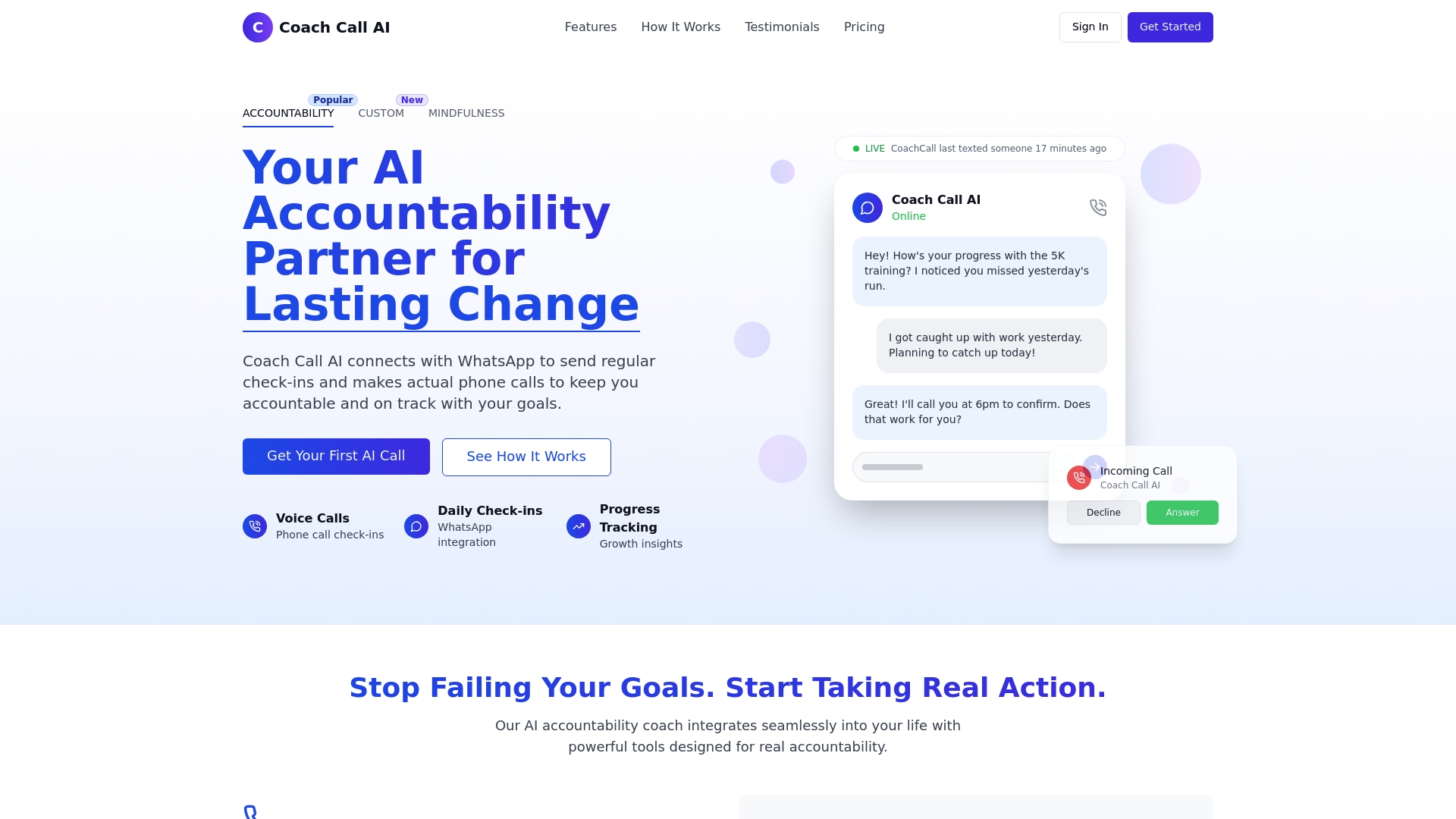
Coach Call AI acts as your personal accountability partner, integrating seamlessly with WhatsApp to provide regular check-ins, motivational messages, and scheduled voice calls. It combines the structure of the GROW model with the urgency of 12-week cycles, offering consistent support that adapts to your schedule and goals. Unlike human accountability partners who have their own commitments and limitations, AI coaching provides reliable check-ins exactly when you need them. For busy professionals and students juggling multiple priorities, this consistent presence transforms sporadic effort into sustained progress. The platform tracks your milestones, celebrates wins, and helps you navigate obstacles with personalized guidance that feels genuinely supportive rather than robotic.
FAQ
What is the best timeframe for setting self-improvement goals?
Twelve weeks creates the optimal balance between urgency and sustainability. 12-week cycles create focus and consistent progress compared to yearly plans that allow procrastination. This timeframe is long enough to achieve meaningful results but short enough to maintain daily awareness and motivation. You'll review progress weekly, adjust quickly, and experience completion frequently enough to build momentum.
How does accountability improve the self-improvement process?
External support transforms intention into action through consistent feedback and social commitment. Accountability increases goal achievement likelihood by 40% because it creates healthy pressure and regular check-ins that prevent drift. When someone else knows your commitments, following through becomes easier than explaining why you didn't. This external structure compensates for the natural motivation fluctuations everyone experiences.
What mindset traits support sustained self-improvement?
Perseverance, adaptability, and emotional regulation form the foundation of lasting change. Resilience and high self-control predict better goal pursuit and self-efficacy across various domains. These traits help you bounce back from setbacks, adjust strategies when initial approaches fail, and maintain effort even when progress feels slow. You can develop these qualities through deliberate practice and reflection.
How can I avoid burnout during my self-improvement journey?
Build recovery into your plan from the start rather than waiting until exhaustion forces it. Iterative mindset promotes adapting to setbacks and reduces negative emotions by framing challenges as learning opportunities. Schedule regular breaks, set realistic targets that account for life's unpredictability, practice positive self-talk, and reflect on progress weekly. Remember that sustainable growth happens through consistency over time, not through unsustainable intensity that leads to collapse.