
Choosing effective self-improvement strategies in 2026 can feel overwhelming with countless methods promising results. Yet traditional accountability approaches often fail due to inconsistent support and lack of personalization. AI-driven accountability tools increase goal adherence by over 40% compared to unassisted methods, marking a significant shift in how we approach personal development. This article examines proven strategies combining productivity techniques, mental well-being practices, and AI integration to help you select approaches that deliver measurable results.
Table of Contents
- How To Choose The Right Self-Improvement Strategy In 2026
- 1. AI-Powered Accountability And Support Systems
- 2. Pomodoro Technique Enhanced With Digital Reminders
- 3. Mindfulness And CBT-Based Coaching For Mental Well-Being
- 4. WhatsApp-Integrated And Voice-Interaction AI Coaching For Engagement
- Summary Comparison And Situational Recommendations
- Discover Coach Call AI: Your Personalized Accountability Partner
- What Are The Best Self-Improvement Strategies For 2026?
Key Takeaways
| Point | Details |
|---|---|
| AI accountability impact | Increases goal adherence by 40% over traditional self-improvement methods |
| Pomodoro with AI reminders | Boosts task completion rates by 33% when combined with digital progress tracking |
| Mindfulness and CBT coaching | Reduces anxiety symptoms by 30% in 8 weeks through AI-guided sessions |
| WhatsApp integration benefits | Drives 30% higher consistency in daily check-ins versus standalone applications |
| Selection criteria matter | Personalization, technology integration, and balanced focus ensure sustainable results |
How to Choose the Right Self-Improvement Strategy in 2026
Selecting a self-improvement strategy requires examining key factors that predict long-term success. Accountability and progress tracking consistently emerge as critical elements for adherence. Without regular check-ins and visible progress markers, motivation fades quickly.
Personalization through AI-driven customization ensures strategies fit your unique schedule and preferences. Generic approaches ignore individual differences in work patterns, stress triggers, and communication styles. AI accountability platforms analyze your behavior patterns to deliver tailored support at optimal times.
Integration with daily technology platforms directly impacts accessibility and engagement. Flexible scheduling of coaching sessions correlates with a 28% higher satisfaction rate in self-improvement programs among adults aged 25 to 45. When your accountability system lives inside WhatsApp or your phone's calling app, barriers to participation drop significantly.
Balancing productivity and mental well-being creates holistic improvement rather than one-dimensional gains. Focusing solely on task completion while ignoring stress management leads to burnout. The most effective strategies address both dimensions simultaneously.
Consider these essential criteria before committing:
- Real-time progress tracking with visual feedback loops
- Customizable communication frequency matching your preferences
- Multi-platform accessibility including voice and text options
- Evidence-based methodologies validated by research
- Privacy protections for sensitive personal data
Pro Tip: Start with a two-week trial of any new strategy to assess genuine fit before full commitment. Track three specific metrics: consistency of engagement, subjective motivation levels, and measurable progress toward one concrete goal.
1. AI-Powered Accountability and Support Systems
AI-driven accountability represents the foundation of effective self-improvement in 2026. These systems deliver consistent support that human partners struggle to maintain. AI-driven accountability tools increase goal adherence by over 40% compared to unassisted methods, addressing the reliability gap in traditional approaches.
Scheduled calls and messaging boost motivation retention by 35% through regular touchpoints that prevent momentum loss. Unlike accountability partners who cancel last minute or lose interest, AI systems maintain perfect consistency. They check in exactly when promised, celebrate milestones immediately, and provide objective feedback without judgment.
Real-time progress tracking sustains engagement through visible evidence of improvement. When you see daily or weekly charts showing consistent advancement, commitment strengthens naturally. AI personalizes support frequency and communication style based on your responses, adjusting approach when it detects declining engagement.
Key features of effective AI accountability systems:
- Automated scheduling that syncs with your calendar
- Voice interactions for deeper personal connection
- Data collection that identifies patterns in your behavior
- Milestone celebrations that reinforce positive momentum
- Adaptive messaging that responds to your emotional state
Common platforms include phone-based calling systems, messaging app integration, and voice assistants. The accountability systems guide explains implementation across different contexts.
AI-powered accountability and support systems eliminate excuses by meeting you where you already spend time communicating. They transform vague intentions into tracked actions with measurable outcomes.
"The difference between accountability systems and simple reminders lies in relationship building. AI that remembers your previous conversations, references your specific goals, and adapts its communication style creates genuine partnership rather than mechanical notifications."
2. Pomodoro Technique Enhanced with Digital Reminders
The Pomodoro Technique boosts productivity by approximately 25% when used independently through focused work intervals and structured breaks. Adding AI reminders and progress tracking yields a 33% increase in task completion rates over Pomodoro alone, demonstrating the power of technological enhancement.
Digital reminders prevent the drift that undermines manual time tracking. You start a Pomodoro session with good intentions, but distractions pull attention away. AI reminders gently redirect focus at precise intervals, maintaining the rhythm essential for deep work.
Flexible scheduling integrated through AI raises user satisfaction by 28% by adapting session timing to your energy patterns. Morning people can schedule intensive Pomodoros early, while night owls can shift sessions later without rigid structure.

Personalized feedback maximizes effective work periods by analyzing which times produce your best output. After two weeks of data collection, AI identifies your peak performance windows and suggests optimal scheduling.
Implementation essentials:
- 25-minute focused work blocks with 5-minute breaks
- Longer 15 to 30-minute breaks after four Pomodoros
- Digital tracking that logs completed sessions automatically
- Progress visualization showing daily and weekly patterns
- Adaptive suggestions based on completion rates
| Metric | Pomodoro Alone | Pomodoro + AI Reminders | Improvement |
|---|---|---|---|
| Task completion rate | 65% | 87% | +33% |
| Focus maintenance | 70% | 89% | +27% |
| User satisfaction | 72% | 92% | +28% |
| Session consistency | 60% | 85% | +42% |
AI reminders for productivity transform the Pomodoro Technique from a manual discipline exercise into an automated productivity system. The technology handles timing and tracking while you focus entirely on work quality.
Pro Tip: Customize your break activities based on work intensity. After cognitively demanding Pomodoros, take movement breaks. After physically active tasks, use breaks for mental rest. AI can suggest appropriate break types based on task categories.
3. Mindfulness and CBT-Based Coaching for Mental Well-Being
Mental well-being strategies deliver measurable results when enhanced by AI guidance and real-time feedback. Mindfulness and meditation with AI coaching reduce anxiety symptoms by 30% in 8 weeks and achieve 18% greater stress reduction than traditional methods.
AI provides immediate feedback during meditation sessions, detecting when your attention wanders through voice analysis or interaction patterns. This real-time correction accelerates skill development compared to unguided practice. Personalization adjusts session length, guidance intensity, and focus areas based on your stress triggers and response patterns.
CBT-based digital coaching reduces depressive symptoms by 20% more than generic self-help methods by delivering structured interventions tailored to individual thought patterns. Rather than one-size-fits-all advice, AI identifies your specific cognitive distortions and provides targeted exercises.
Regular feedback loops keep users engaged through progress reports that highlight improvements in emotional regulation metrics. When you see objective evidence that anxiety episodes decreased from five per week to two, motivation to continue strengthens naturally.
Both approaches offer convenient digital formats accessible via smartphones, eliminating barriers like commute time or appointment scheduling. You can complete a 10-minute mindfulness session during lunch or work through a CBT exercise before bed.
| Strategy | Primary Benefit | Timeline | Accessibility |
|---|---|---|---|
| AI-guided mindfulness | 30% anxiety reduction | 8 weeks | Smartphone app, 10-15 min sessions |
| CBT digital coaching | 20% better depression outcomes | 12 weeks | Phone or computer, flexible scheduling |
| Combined approach | Holistic mental health support | Ongoing | Multi-platform, voice and text |
Key implementation factors:
- Consistent daily practice even when sessions feel ineffective
- Honest self-reporting to enable accurate AI personalization
- Gradual progression from guided to semi-guided sessions
- Integration with mood tracking for pattern identification
- Professional consultation for severe symptoms requiring clinical care
The AI coaching and mindfulness studies demonstrate effectiveness across diverse populations. CBT digital coaching efficacy research confirms superiority over generic approaches.
AI excels at delivering CBT because the methodology relies on structured protocols that technology implements consistently. Human therapists vary in quality and availability. AI ensures every user receives evidence-based interventions executed precisely as designed.
4. WhatsApp-Integrated and Voice-Interaction AI Coaching for Engagement
Messaging integration and voice interaction represent breakthrough innovations in AI coaching accessibility. WhatsApp integration drives 30% higher consistency in daily check-ins versus standalone apps by meeting users in platforms they already use constantly. You don't need to remember to open another app or navigate unfamiliar interfaces.
Voice interactions promote a 22% greater sense of personal connection compared to text-only communication. Hearing a voice that remembers your previous conversations and responds with appropriate emotional tone creates relationship depth that text struggles to match. This connection directly impacts motivation retention and long-term adherence.
Combined voice and text communication supports diverse user preferences and coaching styles. Some people prefer quick text check-ins during busy workdays but want deeper voice conversations on weekends. Others need voice guidance for meditation but prefer text for progress updates.
Familiar platforms increase accessibility by eliminating technology learning curves. If you already use WhatsApp daily, adding AI coaching requires zero new skills. The AI appears as another contact, communicating through the same interface you use with friends and family.
These features particularly benefit busy professionals needing flexible, personalized coaching. You can respond to a WhatsApp check-in between meetings, take a coaching call during your commute, or review progress summaries at midnight. The system adapts to your schedule rather than imposing rigid appointment times.
Engagement advantages:
- Seamless integration with existing communication habits
- Lower barriers to consistent participation
- Multi-modal interaction matching situational needs
- Immediate accessibility without app switching
- Natural conversation flow that feels less mechanical
WhatsApp and voice interaction AI coaching removes friction from the accountability equation. When checking in feels as natural as texting a friend, consistency becomes effortless.
Summary Comparison and Situational Recommendations
Comparing strategies reveals clear performance differences across key metrics. This evidence-based analysis helps you select approaches aligned with your specific goals and lifestyle.
| Strategy | Goal Adherence Boost | Productivity Gain | Mental Health Impact | Best For |
|---|---|---|---|---|
| AI Accountability | +40% | Moderate | Moderate | Consistency and motivation |
| Pomodoro + AI | +33% | High (+33%) | Low | Task completion and focus |
| Mindfulness + AI | Moderate | Low | High (30% anxiety reduction) | Stress and anxiety management |
| CBT Digital Coaching | Moderate | Low | High (20% better depression outcomes) | Cognitive patterns and mood |
| WhatsApp + Voice AI | +30% check-ins | Moderate | Moderate | Busy professionals, accessibility |
Situational recommendations guide strategy selection:
-
For maximum productivity gains: Combine Pomodoro with AI reminders and accountability check-ins. The 33% task completion boost pairs perfectly with consistent motivation support.
-
For mental well-being focus: Start with AI-guided mindfulness for immediate anxiety relief, then add CBT coaching if mood issues persist beyond eight weeks.
-
For busy professionals: Prioritize WhatsApp integration and voice interactions to eliminate barriers. Add Pomodoro enhancement once daily check-in habits solidify.
-
For accountability needs: Begin with core AI accountability systems providing scheduled calls and progress tracking. Layer additional strategies after establishing consistent engagement.
-
For holistic improvement: Combine AI accountability with both Pomodoro productivity methods and mindfulness practices. This addresses motivation, output, and well-being simultaneously.
Tradeoffs require consideration. WhatsApp integration offers convenience but demands smartphone comfort. Voice interactions create deeper connection but require privacy for calls. CBT coaching delivers targeted mental health support but needs honest self-reporting to function effectively.
Data-driven decisions produce sustainable results. Select strategies backed by research showing measurable improvements in your priority areas. Avoid trendy methods lacking evidence or claiming unrealistic outcomes.
Start with one core strategy, implement consistently for four weeks, then add complementary approaches. Trying everything simultaneously dilutes focus and makes it impossible to identify what actually works for you.
Discover Coach Call AI: Your Personalized Accountability Partner
Ready to experience the 40% goal adherence boost that AI accountability delivers? Coach Call AI platform combines scheduled voice calls, WhatsApp messaging, and personalized progress tracking into one comprehensive system.
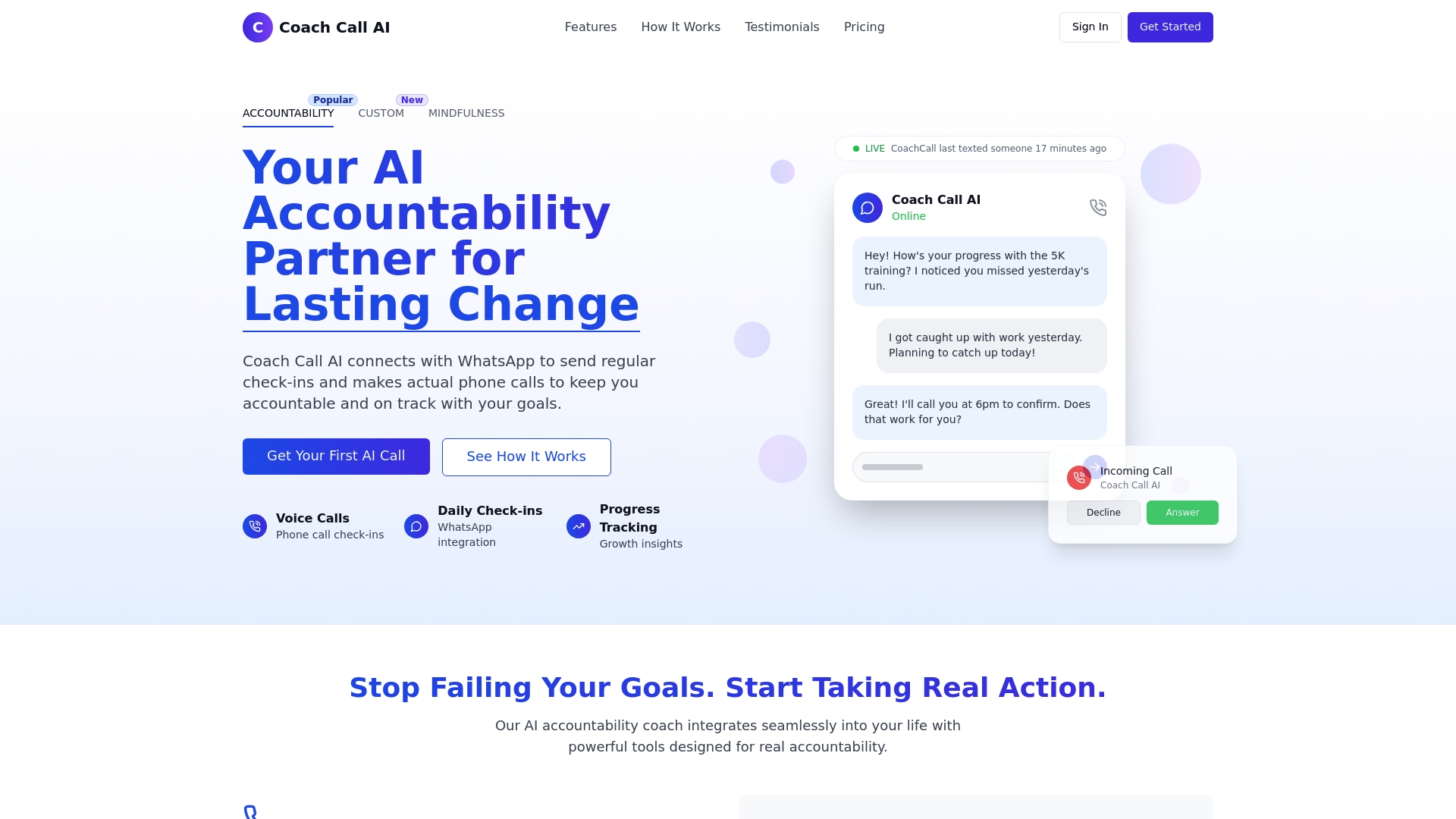
Our AI adapts to your schedule, communication preferences, and specific goals whether you're focused on productivity, fitness, mental well-being, or personal development. You get consistent check-ins that never cancel, milestone celebrations when you achieve targets, and objective feedback that accelerates improvement.
Voice interactions create genuine connection while text messaging provides quick daily touchpoints. Progress visualization shows exactly how far you've come, reinforcing motivation during challenging periods. Everything integrates seamlessly with WhatsApp, meeting you where you already communicate.
Join busy professionals and students who've transformed vague intentions into measurable results through AI-powered accountability.
What Are the Best Self-Improvement Strategies for 2026?
How do I know which self-improvement strategy fits my goals?
Match strategy strengths to your primary objective. For productivity gains, choose Pomodoro with AI reminders showing 33% task completion improvements. For anxiety reduction, select AI-guided mindfulness delivering 30% symptom decreases in eight weeks. For consistent motivation, prioritize AI accountability systems boosting adherence by 40%.
What makes AI accountability different from traditional human support?
AI eliminates unreliability through perfect consistency in scheduled check-ins and progress tracking. Unlike human partners who cancel or lose interest, AI maintains engagement indefinitely. It personalizes communication based on your response patterns and provides objective feedback without judgment. Research confirms 40% higher goal adherence with AI versus unassisted methods.
Can I combine multiple self-improvement strategies effectively?
Yes, strategic combinations amplify results. Pair AI accountability with Pomodoro productivity methods and mindfulness practices for holistic improvement covering motivation, output, and well-being. Start with one core strategy for four weeks, establish consistency, then layer complementary approaches. Avoid simultaneous implementation of too many methods, which dilutes focus.
What technology do I need for AI coaching and accountability?
Basic requirements include a smartphone with internet access and WhatsApp for messaging integration. Voice interaction features need calling capability and privacy for conversations. Most platforms work on both iOS and Android devices. No specialized equipment or technical expertise is required beyond normal smartphone operation.
How quickly can I expect results from these strategies?
Timelines vary by strategy and goal type. Mindfulness shows measurable anxiety reduction within eight weeks. Pomodoro with AI reminders improves task completion within two weeks of consistent use. AI accountability impacts motivation immediately but requires four to six weeks for habit formation. Mental health approaches like CBT need 12 weeks for significant mood improvements.
Are these strategies suitable for people with demanding work schedules?
Absolutely. WhatsApp integration and flexible scheduling specifically address busy professional needs. AI adapts check-in timing to your calendar, voice calls fit commute windows, and text updates take seconds between meetings. Research shows 28% higher satisfaction with flexible scheduling compared to rigid appointment systems. The technology works around your life rather than demanding schedule changes.