
You might assume coaching sessions are inherently private, but that assumption can sabotage your progress. Without explicit privacy protections, many busy professionals and students hold back crucial details, limiting the accountability and mental well-being gains coaching promises. Privacy isn't an afterthought in effective coaching; it's the foundation that enables honest conversations, deeper trust, and measurable results. This guide explores how privacy mechanisms work in coaching, why they matter for your personal development, and how to choose coaching formats that protect your information while maximizing your growth in 2026.
Table of Contents
- Why Privacy Matters In Coaching: The Foundation For Accountability And Growth
- How Coaching Privacy Works: Agreements, Systems, And Behaviors That Protect You
- Balancing Traditional And Digital Coaching Privacy: Benefits And Challenges In 2026
- Practical Tips For Choosing Privacy-Conscious Coaching For Accountability And Well-Being
- Experience Private, Accountable Coaching With Coach Call AI
- Frequently Asked Questions
Key takeaways
| Point | Details |
|---|---|
| Privacy enables honest sharing | Without clear confidentiality, clients self-censor and limit coaching effectiveness for accountability and mental health. |
| Three layers protect you | Coaching privacy relies on explicit agreements, secure technology systems, and trusted practitioner behaviors. |
| Digital coaching can be private | Privacy-by-design and user data control make digital coaching as confidential as traditional methods when implemented correctly. |
| Balance optimizes results | Combining human trust with secure technology maximizes coaching effectiveness while protecting your information. |
| Verify before you start | Knowing privacy practices helps you choose coaches that safeguard your data and build the trust needed for transformation. |
Why privacy matters in coaching: the foundation for accountability and growth
Privacy creates the safe space where real coaching happens. When you know your words won't leave the room, you share the messy, uncomfortable truths that actually need attention. Privacy and confidentiality enable clients to openly share sensitive information critical for personal accountability and mental well-being without fear of exposure. This matters especially for busy professionals and students who face public scrutiny in their daily lives.
Without clear confidentiality boundaries, you'll naturally hold back. You might skip mentioning the panic attacks before presentations or the relationship conflicts affecting your focus. That self-censorship kills coaching effectiveness because your coach can't help with problems they don't know exist. The result? You pay for coaching but get surface-level advice that doesn't address root issues.
Technology-enabled coaching improves mental health outcomes significantly when privacy enables deeper disclosure. Studies show meaningful reductions in depression, anxiety, and stress when clients feel safe sharing openly. For individuals juggling demanding careers or academic pressures, this protected space becomes essential for processing challenges without risking professional reputation or social standing.
The International Coaching Federation Code mandates confidentiality even when employers pay for coaching sessions. This protection ensures you can discuss workplace frustrations, career doubts, or leadership struggles without information flowing back to your boss. Well-defined privacy directly improves accountability because you'll actually follow through on commitments when you've been honest about what's blocking you.
"Privacy isn't just about keeping secrets. It's about creating conditions where you can be completely honest with yourself and your coach about what's really happening in your life."
Consider these privacy benefits for your coaching journey:
- Trust builds faster when confidentiality boundaries are explicit and enforced
- Honest disclosure leads to targeted interventions that address actual problems
- Accountability increases when you're not performing for an audience
- Mental well-being improves through processing sensitive issues safely
- Progress accelerates because coaching addresses root causes, not symptoms
For students managing mental health alongside academic pressure, student mental health coaching with strong privacy protections removes barriers to seeking help. You can explore anxiety, motivation issues, or identity questions without worrying about academic records or parental notification. This confidential support system becomes a critical resource for navigating developmental challenges while maintaining privacy in an increasingly surveilled digital environment.
How coaching privacy works: agreements, systems, and behaviors that protect you
Coaching privacy isn't magic or trust alone. It operates through three distinct layers: agreements, systems, and behaviors that work together to safeguard your information. Understanding these mechanisms helps you evaluate whether a coach or platform actually protects your privacy or just claims to.
The first layer is explicit agreements that define exactly what stays private and what doesn't. Before coaching begins, you should receive a clear contract spelling out confidentiality scope and specific exceptions like legal obligations or imminent harm situations. These agreements build initial trust by removing ambiguity about information handling.
The second layer involves technological safeguards that minimize your digital footprint. Secure systems use encrypted communication channels, avoid storing session notes digitally, and keep coaching appointments off shared calendars. Some coaches deliberately use phone calls instead of video to reduce data creation. The goal is limiting the information trail that could be breached or subpoenaed.

The third layer is practitioner behavior that consistently honors privacy commitments. Trusted coaches use verbal scripts that remind clients about confidentiality at session starts. When sharing case studies or examples, they anonymize details thoroughly so individuals can't be identified. These behavioral habits reinforce that privacy protection is active, not just paperwork.
Here's how to verify these layers before starting coaching:
- Request the confidentiality agreement in writing and review exceptions carefully
- Ask specifically about digital note storage, encryption standards, and data retention policies
- Inquire whether session recordings are created and how they're secured or destroyed
- Confirm how the coach handles case studies and whether your stories might appear in marketing
- Verify backup systems and who has access to any stored information
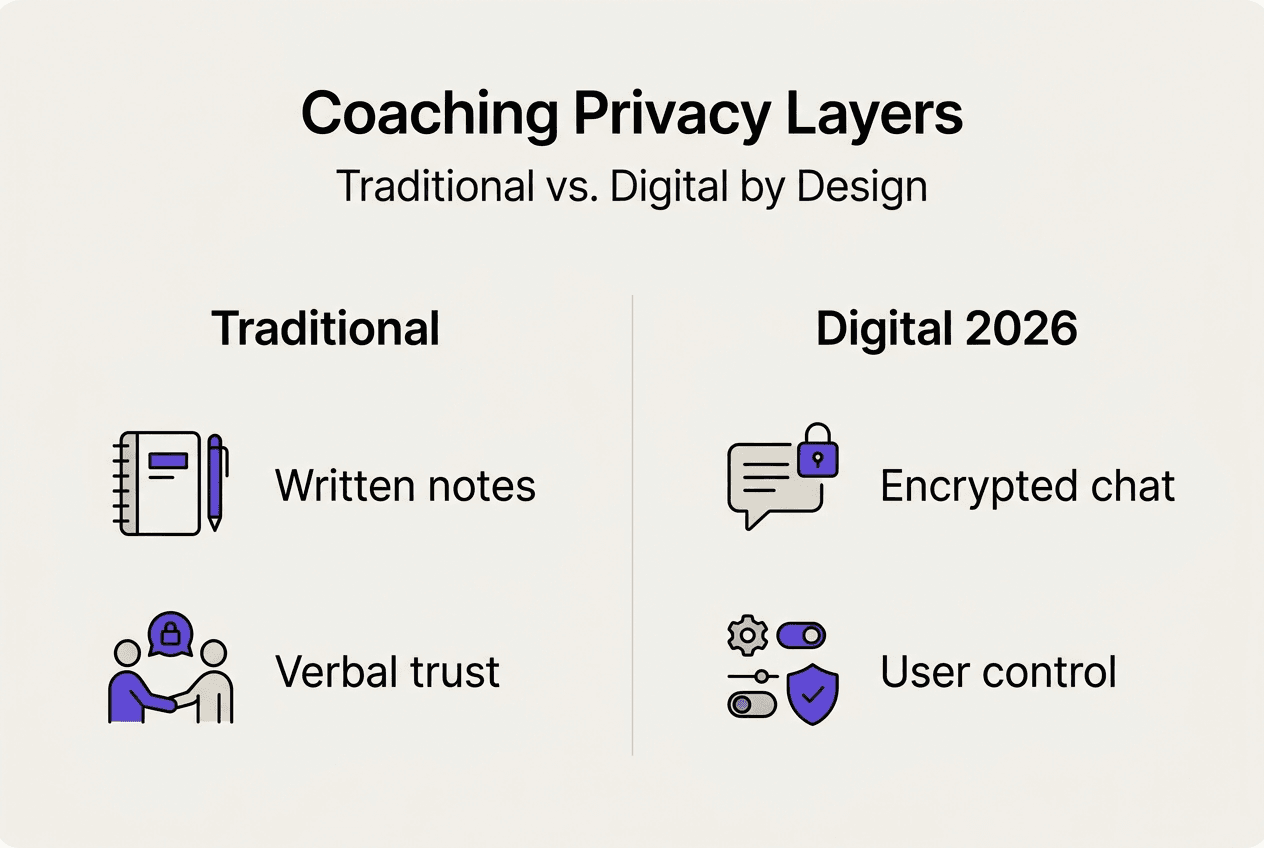
| Privacy Layer | Traditional Coaching | Digital with Privacy-by-Design |
|---|---|---|
| Agreements | Written contracts, verbal reminders | Explicit consent flows, granular permissions |
| Systems | Paper notes, encrypted phones | End-to-end encryption, zero storage, local processing |
| Behaviors | Anonymized examples, private offices | Automated anonymization, audit trails, user data dashboards |
| Data Control | Coach holds information | User controls sharing and deletion |
| Breach Risk | Physical theft, eavesdropping | Hacking, cloud breaches, tracking |
Pro Tip: Before choosing a coach, verify their privacy protocols exceed industry minimums, especially regarding digital storage and encryption standards. Ask for specific technology names and security certifications.
Understanding how data drives accountability in AI coaching helps you appreciate why system design matters so much. When coaching platforms collect behavioral data for progress tracking, privacy-by-design ensures that information serves you without creating vulnerability. User control over what's collected, how it's used, and when it's deleted transforms data from a privacy threat into an accountability tool.
Balancing traditional and digital coaching privacy: benefits and challenges in 2026
Traditional face-to-face coaching and digital coaching AI each bring distinct privacy profiles. Traditional coaching relies heavily on contracts and human trust but operates with fewer regulatory protections than therapy. You're trusting the coach's character and professional standards, which works well with vetted practitioners but offers limited recourse if privacy is violated.
Digital coaching dramatically expands accessibility and scalability, making accountability support available to busy professionals and students who can't commit to regular in-person appointments. However, technology introduces new risks like data breaches, algorithmic bias, and tracking that traditional coaching avoids entirely. The convenience of WhatsApp check-ins or AI-driven voice calls comes with questions about where your data lives and who can access it.
Privacy-by-design principles change this equation significantly. When digital platforms embed privacy protections from the start and give you control over data sharing, trust increases substantially. Privacy-by-design in AI coaching means encryption is default, data minimization is built in, and you decide what information the system retains. This approach makes digital coaching viable even for sensitive personal development work.
| Feature | Traditional Coaching | Digital Coaching (Privacy-by-Design) |
|---|---|---|
| Accessibility | Limited by geography, schedules | Available anytime, anywhere via phone or messaging |
| Privacy Foundation | Human trust, professional ethics | Encryption, user control, technical safeguards |
| Regulatory Oversight | Minimal compared to therapy | Emerging standards, GDPR compliance |
| Data Creation | Minimal (paper notes, memory) | Potentially extensive (messages, voice, behavioral data) |
| Breach Risk | Physical access, eavesdropping | Hacking, cloud vulnerabilities, third-party access |
| Scalability | One coach, limited clients | AI enables unlimited concurrent users |
Practical privacy risks in digital coaching include:
- Cloud storage vulnerabilities where session data could be accessed by platform employees or hackers
- Algorithmic bias that might misinterpret cultural context or sensitive disclosures
- Behavioral tracking that creates detailed profiles of your habits, emotions, and struggles
- Third-party integrations that share your information with analytics or advertising services
- Data retention policies that keep your information longer than necessary for coaching purposes
Pro Tip: If privacy is your top concern, ask about zero digital footprint options where sessions leave no stored record. Some coaches offer phone-only sessions with no notes, ideal for sensitive cases.
Balancing both methods optimizes coaching effectiveness. Hybrid coaching boosts goal adherence by combining human empathy with AI consistency while managing privacy through layered protections. You might use digital coaching for daily accountability check-ins where privacy risks are lower, then schedule traditional sessions for deeper emotional work requiring maximum confidentiality. This strategic approach gives you convenience without sacrificing privacy where it matters most.
Practical tips for choosing privacy-conscious coaching for accountability and well-being
Selecting a coach or platform that honors privacy while delivering accountability results requires asking specific questions and verifying claims. Start by confirming the coach uses encrypted communication channels for all interactions. Standard phone calls offer more privacy than unencrypted video platforms that create recordings or allow screen capture.
Look for clear contracts that outline confidentiality scope, specific exceptions, and information sharing boundaries. The agreement should address what happens to your data if coaching ends, whether testimonials require your consent, and how the coach handles legal requests for information. Vague privacy policies are red flags suggesting the coach hasn't thought through protection mechanisms.
Choose platforms offering user control over data collection and usage. Privacy-by-design in AI coaching means you decide what information the system collects, how long it's retained, and whether it's used for algorithm training. Granular permissions let you share behavioral data for progress tracking while keeping emotional disclosures completely private. This control transforms privacy from something done to you into something you actively manage.
Consider digital coaching's convenience carefully but scrutinize privacy features before committing. AI coaching can provide consistent accountability for busy schedules, but verify the platform's encryption standards, data storage locations, and third-party access policies. Zero-digital-footprint guarantees mean sessions leave no stored record, ideal when discussing sensitive personal or professional matters.
Questions to ask your coach about privacy:
- What encryption do you use for calls, messages, and any stored information?
- Where is my data physically stored, and who has access to it?
- Do you take notes during sessions, and if so, are they digital or paper?
- What are the specific exceptions to confidentiality, and how are they handled?
- How long do you retain my information after coaching ends?
- Will my stories or data ever be used in case studies, research, or marketing?
- What happens to my data if your business closes or you change platforms?
- Can I request deletion of my information at any time?
Pro Tip: Regularly review and update your consent preferences when using AI or digital coaching platforms. Privacy needs change as your coaching focus shifts from career goals to personal relationships or mental health.
Practical privacy decisions directly impact your accountability and stress levels. When you trust your coach won't share your struggles, you'll actually discuss the procrastination, self-doubt, or relationship conflicts blocking your goals. This honesty enables targeted interventions that produce measurable results. AI personal development for accountability works best when privacy protections remove the fear of exposure that causes self-censorship.
For professionals seeking AI coaching for productivity, verify that workplace performance data shared with your AI coach stays separate from employer systems. You want accountability support that helps you improve without creating a surveillance record your boss can access. Clear data boundaries let you use coaching tools freely without worrying about professional consequences.
Experience private, accountable coaching with Coach Call AI
If you're ready to experience coaching that combines strong privacy protections with consistent accountability, Coach Call AI offers a solution designed for 2026's privacy-conscious professionals and students. The platform uses encrypted phone and WhatsApp calls to deliver confidential coaching sessions that leave minimal digital footprint. You control what data is collected and how it's used, building trust through transparency rather than asking for blind faith.
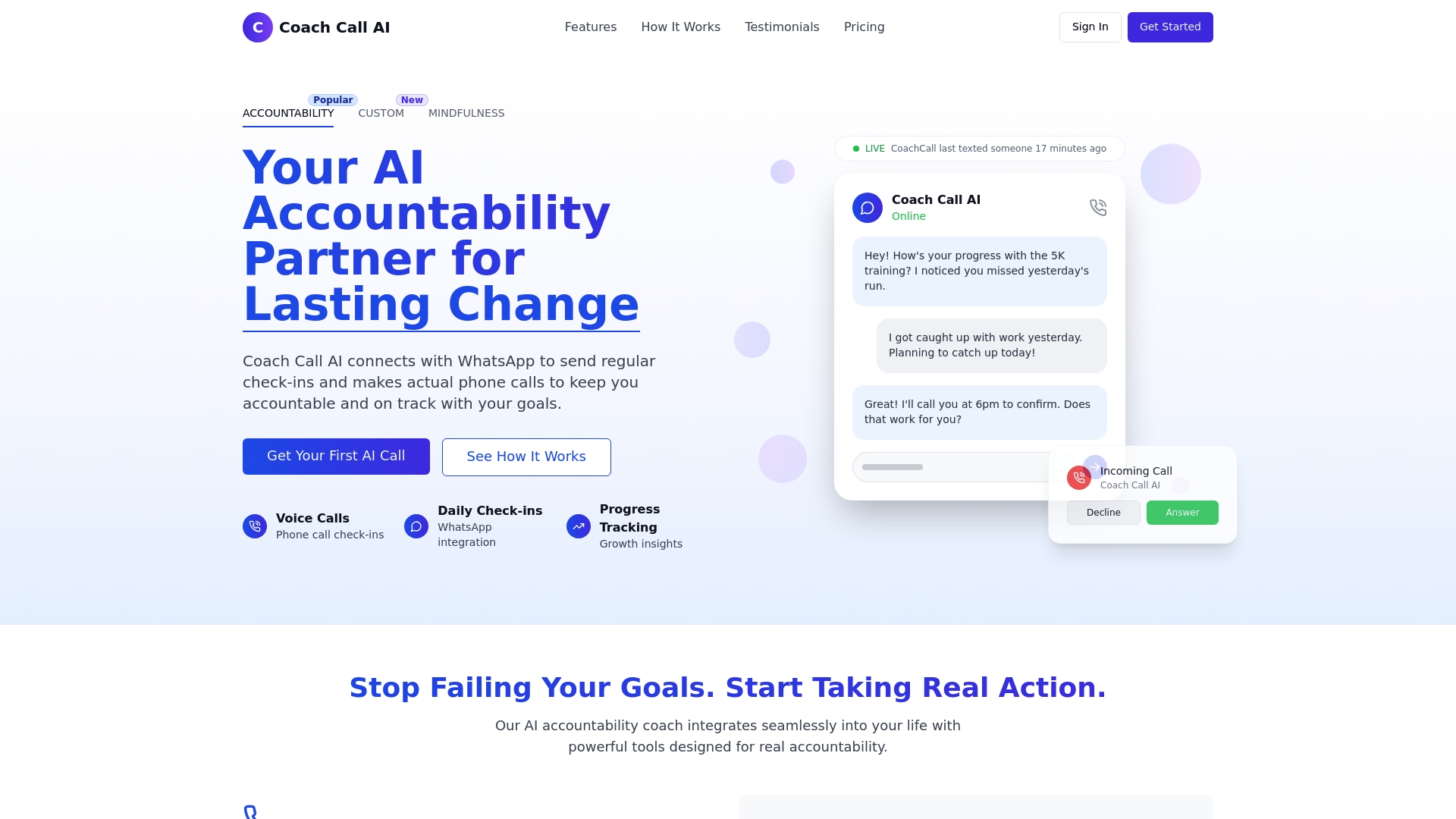
Coach Call AI integrates privacy-by-design principles with AI-driven accountability, giving you regular check-ins and progress tracking without exposing sensitive personal information. The system provides motivational support and goal monitoring through secure channels, ideal for busy individuals who need consistent coaching but value their privacy. Try Coach Call AI to see how protected, personalized coaching can accelerate your growth while respecting your confidentiality needs.
Frequently asked questions
What is the role of privacy in coaching?
Privacy creates the safe environment necessary for honest sharing, which is the foundation of effective coaching. When you trust that your words won't be exposed, you'll discuss the real obstacles blocking your progress rather than presenting a sanitized version of your challenges. This honesty enables your coach to provide targeted support that addresses root causes instead of symptoms. For busy professionals and students, privacy protection removes the fear of reputational damage that often prevents people from seeking accountability help. Strong confidentiality directly improves mental well-being outcomes because you can process difficult emotions and situations without worrying about social or professional consequences.
How does digital coaching ensure client privacy?
Digital coaching platforms protect privacy through privacy-by-design principles and user control over data sharing decisions. Technology like end-to-end encryption secures communication channels so messages and calls can't be intercepted. Explicit consent mechanisms let you choose what information the system collects and how it's used, transforming privacy from a passive hope into an active choice. Well-designed platforms minimize data creation by processing information locally rather than storing everything in the cloud. User dashboards show exactly what data exists and provide deletion options, giving you ongoing control over your digital footprint. These technical safeguards, combined with clear privacy policies, make digital coaching viable even for sensitive personal development work.
What should I ask my coach about privacy before starting?
Before beginning coaching, request the confidentiality agreement in writing and review it carefully for scope and exceptions. Ask specifically about data storage policies, including whether notes are digital or paper and how long information is retained. Inquire about encryption standards for calls and messages, and verify whether sessions are recorded. Confirm how your data is used, whether stories might appear in case studies, and who has access to your information. Ask about the coach's procedures for handling legal requests or situations involving potential harm. Verify backup systems and what happens to your data if coaching ends or the coach's business closes. These questions reveal whether privacy protection is genuine or just marketing language.
Can coaching improve mental health outcomes while protecting privacy?
Yes, technology-enabled coaching produces significant mental health improvements including reductions in depression, anxiety, and stress when strong privacy protections enable open disclosure. Studies demonstrate that coaching with clear confidentiality boundaries leads to deeper sharing, which is essential for addressing mental health challenges effectively. Privacy allows you to discuss sensitive topics like panic attacks, relationship conflicts, or self-doubt without fear of exposure. This protected environment is particularly valuable for busy professionals and students who face public scrutiny and can't risk their struggles becoming known. The combination of evidence-based coaching techniques and robust privacy safeguards creates conditions where meaningful mental health progress becomes possible alongside professional and academic success.