
You set ambitious goals every year, yet most slip away within weeks. The problem isn't motivation or willpower, it's the absence of a structured plan that turns intentions into consistent action. Without clear milestones, accountability systems, and progress verification, self-improvement efforts dissolve into forgotten resolutions. This guide delivers a proven framework to help you design, execute, and sustain goal plans that actually work, transforming your aspirations into measurable achievements through practical strategies tailored for busy lives.
Table of Contents
- Key takeaways
- Preparing for successful self-improvement goal planning
- Step-by-step execution of your self-improvement goal plan
- Verifying progress and maintaining motivation in your self-improvement journey
- Enhance your goal planning with AI coaching support
- What are the best tools for tracking self-improvement goals?
Key Takeaways
| Point | Details |
|---|---|
| Clear SMART Goals | Define SMART goals that specify what to achieve, why it matters, and a clear finish line. |
| Dedicated Time and Space | Set aside dedicated time and a quiet space to focus on self improvement tasks. |
| Milestones with Deadlines | Break the main goal into milestones with their own deadlines to maintain momentum and clarity. |
| Accountability and Tracking | Put accountability mechanisms in place and monitor progress so you can adjust when obstacles appear. |
| Two Minute Rule | Apply the two minute rule by completing tasks that take under two minutes immediately. |
Preparing for successful self-improvement goal planning
You can't build a house without a blueprint, and self-improvement works the same way. Clear and precise goal setting is critical for success in self-improvement, yet most people skip this foundational step and wonder why their efforts collapse. Before you dive into action, you need to establish exactly what you want to achieve and why it matters to you personally.
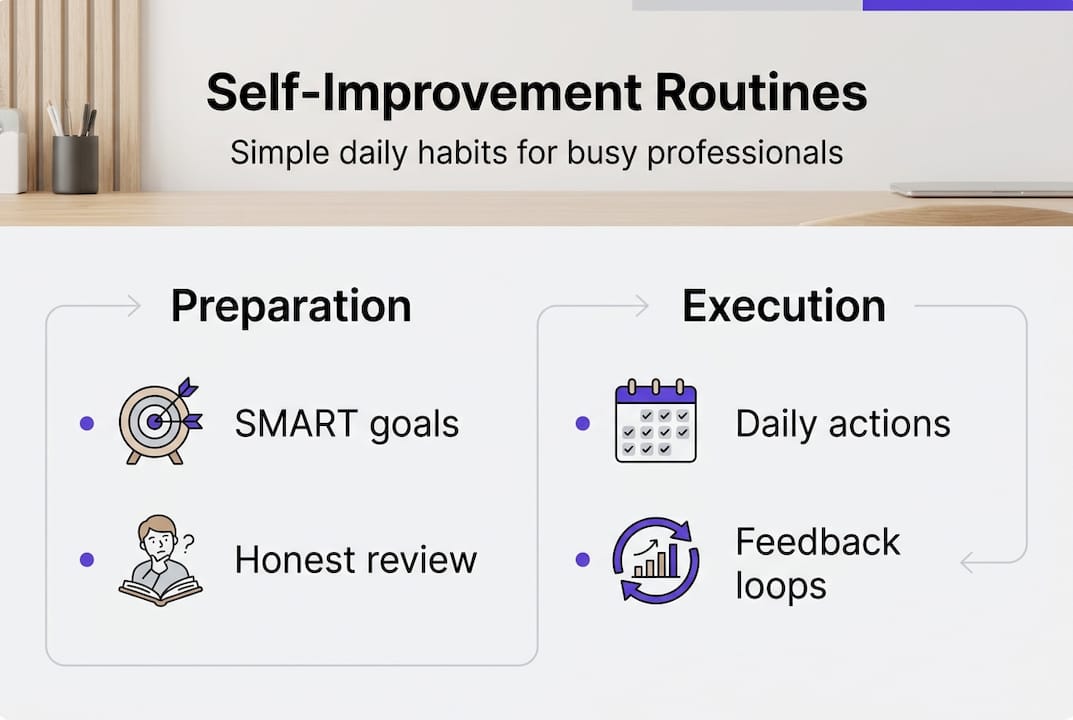
Start by defining SMART goals: specific, measurable, achievable, relevant, and time-bound. Instead of "get healthier," you'd commit to "exercise for 30 minutes five days per week for the next three months." The difference is night and day. Vague aspirations create confusion, while precise targets give you a clear finish line and measurable checkpoints along the way.
Next, assess your current routines honestly. What habits already support your goals? Which ones sabotage your progress? If you want to wake up earlier but scroll social media until midnight, you've identified a barrier that needs addressing. Write down your typical daily schedule and highlight time blocks where you can realistically insert new behaviors without overwhelming yourself.
Prepare your mindset to embrace accountability and sustained effort. Self-improvement isn't a sprint where you push hard for two weeks and coast. It's a marathon requiring consistent small steps, occasional setbacks, and the resilience to keep moving forward. Acknowledge that discomfort and resistance will show up, and that's normal.
Create a dedicated time and space to focus on personal development. This might mean waking up 20 minutes earlier for reflection, blocking lunch breaks for skill-building, or designating Sunday evenings for weekly reviews. Physical space matters too. A quiet corner with minimal distractions signals to your brain that it's time to work on yourself.
Pro Tip: Use the "two-minute rule" during preparation. If a task takes less than two minutes, do it immediately. This builds momentum and prevents small tasks from piling up into overwhelming barriers.
Consider how self-improvement routines for busy lives can fit into your existing schedule without requiring a complete lifestyle overhaul. The goal is integration, not disruption. When you align your self-improvement plan with your real-world constraints and energy patterns, you dramatically increase the odds of long-term success.
Step-by-step execution of your self-improvement goal plan
Preparation sets the stage, but execution is where transformation happens. You need a structured approach that converts your goals into daily actions, tracks progress systematically, and adapts when obstacles appear. Behavioral coaching methods can lead to an 80% success rate in self-improvement, proving that the right system makes all the difference.
Break down your main goal into smaller, manageable milestones. If your goal is to write a book in six months, your milestones might include completing an outline in week one, writing 500 words daily, and finishing the first draft by month four. Each milestone becomes a mini-goal with its own deadline and success criteria. This approach prevents overwhelm and gives you frequent wins that fuel motivation.
Here's how to structure your execution plan:
-
Define your daily non-negotiables. These are the core actions that move you toward your goal every single day. For fitness, it might be a 20-minute workout. For learning, it could be reading 10 pages or practicing a skill for 15 minutes. Keep the list short, typically one to three items.
-
Schedule these actions at specific times. "Exercise sometime today" rarely happens. "Exercise at 6:30 AM before breakfast" creates a concrete commitment. Treat these appointments with yourself as seriously as you'd treat a meeting with your boss.
-
Build accountability checkpoints. Weekly reviews let you assess what's working and what needs adjustment. Monthly reviews reveal larger patterns and progress trends. Share your goals with a friend, join a community, or use coaching support to maintain external accountability.
-
Prepare for obstacles in advance. What will you do when motivation dips? How will you handle a busy week? Having backup plans prevents one bad day from derailing your entire effort.
Use daily and weekly routines to build accountability and momentum. Consistency matters more than intensity. Doing a little bit every day beats sporadic bursts of effort followed by long gaps. Your brain adapts to patterns, so when you perform the same action at the same time repeatedly, it becomes automatic over time.
Leverage digital tools and AI-driven apps to monitor your progress. Habit trackers, goal-setting apps, and tracking personal development milestones platforms provide visual feedback that reinforces your efforts. Seeing a streak of completed days creates psychological momentum that makes you less likely to break the chain.
Consider how AI accountability for personal development can provide the consistent check-ins and reminders that human accountability partners sometimes fail to deliver. Automated systems don't forget, don't judge, and don't get too busy to follow up.
Adapt your plan based on regular reviews and feedback. If you're consistently missing your daily target, it might be too ambitious. If you're breezing through without challenge, you might need to raise the bar. Flexibility isn't failure, it's intelligent adjustment based on real-world data.

Pro Tip: Track your energy levels alongside your actions. You might discover that you're most focused in the morning but scheduling difficult tasks in the evening. Aligning task difficulty with your natural energy rhythms dramatically improves execution quality.
Here's a sample weekly execution framework:
| Day | Primary Action | Review Checkpoint | Adjustment Notes |
|---|---|---|---|
| Monday | Execute daily non-negotiable | Evening reflection | Note energy levels |
| Tuesday | Execute daily non-negotiable | Evening reflection | Identify obstacles |
| Wednesday | Execute daily non-negotiable | Evening reflection | Celebrate small wins |
| Thursday | Execute daily non-negotiable | Evening reflection | Track completion rate |
| Friday | Execute daily non-negotiable | Evening reflection | Plan weekend approach |
| Saturday | Execute daily non-negotiable | Evening reflection | Assess weekly progress |
| Sunday | Execute daily non-negotiable | Weekly review session | Adjust next week's plan |
This structure creates predictability while building in regular feedback loops that keep you responsive to what's actually happening in your life.
Verifying progress and maintaining motivation in your self-improvement journey
Following your active efforts, verifying and adapting your plan ensures you remain motivated and effectively on track toward your goals. Progress isn't always linear, and understanding how to measure real advancement versus temporary fluctuations separates those who succeed long-term from those who give up prematurely.
Regularly measure your progress against milestones and make adjustments as needed. Weekly check-ins reveal immediate issues, while monthly reviews show broader trends. Ask yourself specific questions: Did I complete my daily actions at least 80% of the time? Am I moving closer to my milestone? What obstacles appeared, and how did I handle them? Data-driven reflection beats vague feelings every time.
Understand common setbacks and how to manage them effectively. You'll face motivation dips, unexpected life events, and plateaus where progress seems to stall. These aren't signs of failure, they're normal parts of any improvement journey. The key is responding strategically rather than emotionally.
Here's how to handle typical setbacks:
-
Motivation loss: Return to your original "why." Reconnect with the deeper reason you started this goal. If you can't remember why it matters, the goal itself might need reevaluation.
-
Time crunches: Implement your minimum viable action. Can't do 30 minutes? Do 10. Can't write 500 words? Write 100. Maintaining the habit matters more than hitting the ideal number.
-
Plateaus: These often signal that your body or brain is consolidating gains before the next leap. Trust the process, stay consistent, and look for non-scale victories like improved energy or better focus.
-
Comparison traps: Someone else's highlight reel isn't your reality. Focus on your own progress compared to where you started, not where others appear to be.
Use coaching and hybrid support to maintain motivation and improve adherence. Hybrid coaching approaches can improve goal adherence by 30%, combining the personalization of human insight with the consistency of automated systems. This dual approach addresses both the emotional and practical aspects of staying on track.
Distinguish between short-term fluctuations and long-term trends in your journey. Weight fluctuates daily due to water retention and meal timing, but the trend over weeks reveals real change. Similarly, one unproductive day doesn't mean your productivity system failed. Three consecutive unproductive weeks suggests something needs adjustment.
Pro Tip: Create a "wins journal" where you record daily victories, no matter how small. On difficult days, reviewing past successes reminds you of your capability and progress.
Consider implementing custom coaching plans tailored to your specific challenges and learning style. Generic advice works for generic people. Personalized strategies address your unique obstacles, schedule constraints, and motivation triggers.
A structured coaching workflow provides the framework for consistent progress verification. Regular check-ins, milestone celebrations, and obstacle problem-solving sessions keep you engaged and accountable throughout your journey.
Here's a comparison of verification approaches:
| Verification Method | Frequency | Best For | Limitations |
|---|---|---|---|
| Daily self-reflection | Every evening | Immediate course correction | Can miss bigger patterns |
| Weekly progress review | Sunday evenings | Identifying weekly trends | Requires dedicated time |
| Monthly milestone assessment | Last day of month | Long-term trend analysis | Less responsive to daily issues |
| Coaching check-ins | Weekly or biweekly | External accountability and perspective | Requires commitment and investment |
| AI-driven tracking | Continuous | Real-time data and reminders | May lack nuanced human insight |
The most effective approach combines multiple methods, creating a comprehensive verification system that catches both immediate issues and long-term drift.
Enhance your goal planning with AI coaching support
You've learned the framework for effective goal planning, but even the best system works better with consistent accountability. Personalized AI coaching can increase commitment to your goals by providing the regular check-ins and motivation that traditional methods often lack. Services like Coach Call AI offer phone and WhatsApp accountability, delivering timely reminders and encouragement exactly when you need them most.
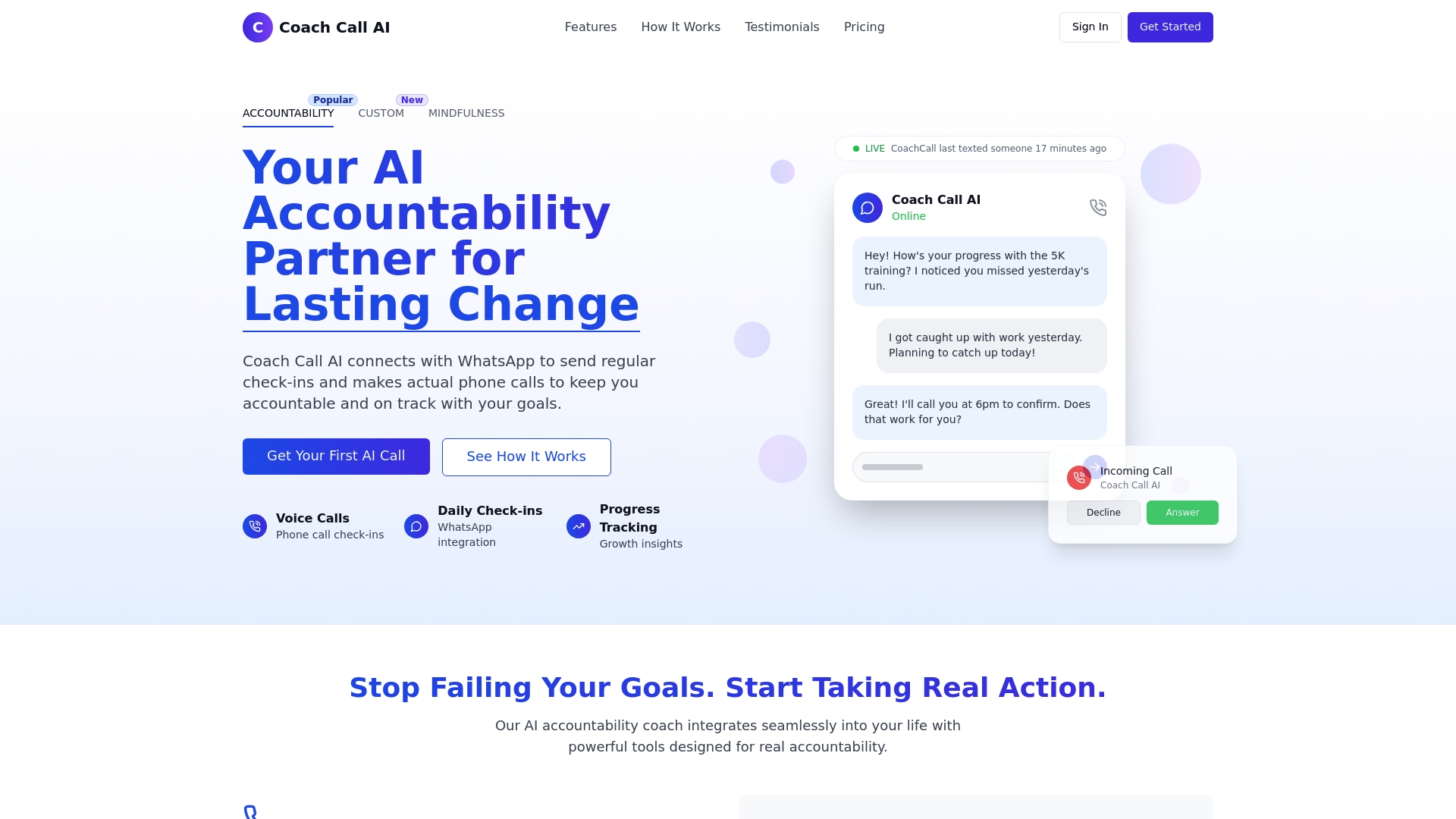
Integrating coaching tools complements your self-improvement strategy by filling the accountability gap that derails so many well-intentioned plans. Instead of relying solely on willpower, you gain a system that actively supports your progress through automated check-ins, progress tracking, and personalized feedback. This combination of your structured plan and AI-driven support creates a powerful ecosystem for lasting change.
What are the best tools for tracking self-improvement goals?
Digital planners, habit trackers, and AI coaching apps are effective tools for monitoring progress. They offer reminders, insights, and motivation that paper systems can't match. Popular options include Habitica for gamified tracking, Notion for comprehensive planning, and specialized AI coaching platforms for accountability.
Choosing tools depends on your preferences and the complexity of goals. Simple goals might need only a basic habit tracker, while multifaceted objectives benefit from integrated systems that track multiple metrics. The best tool is the one you'll actually use consistently.
How can busy professionals maintain accountability in self-improvement?
Incorporate short, consistent routines and use reminders or coaching support to stay accountable even with a busy schedule. The key is finding micro-habits that fit into existing gaps rather than requiring major schedule overhauls. A 10-minute morning routine beats an hour-long session you never have time for.
Prioritize small daily wins and leverage AI tools to maintain momentum. Self-improvement routines for busy lives focus on high-impact actions that deliver results without demanding unrealistic time commitments. Automated reminders and progress tracking remove the mental burden of remembering and monitoring.
What common mistakes should I avoid in goal planning?
Avoid vague goals, all-or-nothing thinking, neglecting progress review, and lacking clear accountability measures. Vague goals create confusion about what success looks like. All-or-nothing thinking turns minor setbacks into complete failures. Skipping reviews means you miss early warning signs that your plan needs adjustment.
Use realistic timelines and flexibility to adjust your plan as needed. Overly ambitious deadlines set you up for frustration, while flexible systems allow for life's unpredictability. The goal is sustainable progress, not perfect execution.
How effective is AI coaching in improving self-improvement goal adherence?
Research shows AI-supported coaching improves adherence to self-improvement goals by about 30%. This significant boost comes from consistent check-ins that human accountability partners can't always provide. The combination of human insight and AI consistency creates a powerful support system.
Such coaching offers timely reminders, personalized feedback, and motivation through multiple channels. Whether through WhatsApp messages, scheduled calls, or app notifications, AI accountability partner systems meet you where you are, adapting to your preferences and schedule. This accessibility makes maintaining momentum far easier than traditional coaching alone.