
Procrastination isn't laziness. It's an emotion regulation problem rooted in fear, perfectionism, and overwhelm that derails even the most motivated students and professionals. Traditional advice like "just do it" fails because it ignores the underlying psychology driving delay. Personalized procrastination coaching addresses these root causes through evidence-based techniques, accountability frameworks, and tailored strategies that transform chronic avoiders into consistent achievers. Whether you're a student paralyzed by assignment deadlines or a busy professional buried under competing priorities, specialized coaching offers a structured path to reclaim your time and momentum.
Table of Contents
- Key takeaways
- What is procrastination coaching and who benefits the most
- Core techniques and methodologies used in procrastination coaching
- Evidence and nuances: how effective is procrastination coaching?
- AI-driven procrastination coaching: the next evolution in personalized support
- Discover AI accountability coaching for procrastination
- FAQ
Key Takeaways
| Point | Details |
|---|---|
| Root cause focus | Procrastination coaching targets the emotional and cognitive drivers behind delay such as fear of failure, perfectionism, task ambiguity, and emotional avoidance using evidence based techniques and accountability. |
| Who benefits | Students facing assignment paralysis, busy professionals juggling competing demands, and neurodiverse individuals such as those with ADHD benefit from tailored support including visual timers, body doubling, and frequent check ins. |
| Core techniques | Coaching combines diagnosing drivers, SMART goal setting, time management methods like Pomodoro, behavioral activation, cognitive restructuring through CBT and motivational interviewing, environment redesign, and weekly accountability. |
| Program structure | The model typically uses four 45 to 60 minute sessions over four weeks with weekly check ins to monitor progress and adjust strategies. |
What is procrastination coaching and who benefits the most
Procrastination coaching is a specialized practice that helps individuals overcome chronic delay by addressing the emotional and cognitive barriers beneath surface behaviors. Unlike generic productivity advice, coaching tackles root causes such as fear of failure, perfectionism, task ambiguity, and emotional avoidance through personalized, accountability-focused strategies. This approach recognizes that procrastination stems from executive function challenges and emotion regulation difficulties, not character flaws.
Students facing assignment paralysis and busy professionals juggling competing demands form the primary audience for this coaching style. Students often struggle with unstructured time, unclear expectations, and performance anxiety that trigger avoidance cycles. Professionals deal with decision fatigue, conflicting priorities, and the stress of high-stakes deliverables. Both groups benefit from external accountability structures and customized frameworks that break overwhelming tasks into manageable steps.
Neurodiverse individuals, particularly those with ADHD, represent another critical beneficiary group. Executive function deficits make task initiation, time estimation, and sustained focus exceptionally difficult. Procrastination coaching provides the scaffolding these individuals need through visual timers, body doubling techniques, and frequent check-ins that compensate for working memory limitations. For comprehensive mental health support strategies, explore our student mental health coaching guide.
The coaching process typically addresses five core procrastination drivers:
- Fear of failure or judgment that freezes action before it starts
- Perfectionism creating impossibly high standards that paralyze progress
- Task ambiguity where unclear next steps trigger avoidance
- Emotional discomfort from boring, frustrating, or anxiety-inducing work
- Executive function deficits affecting planning, prioritization, and follow-through
By diagnosing which combination of factors drives your specific procrastination pattern, coaches design interventions that target your actual obstacles rather than applying one-size-fits-all productivity hacks. This personalized approach explains why coaching succeeds where generic time management advice fails.
Core techniques and methodologies used in procrastination coaching
Effective procrastination coaching employs a structured yet flexible methodology that combines behavioral science, cognitive techniques, and accountability systems. Most programs follow a brief intervention model: four 45 to 60 minute sessions spread over four weeks, with weekly check-ins between sessions to maintain momentum and adjust strategies based on real-world results.

The core methodologies include diagnosing procrastination drivers, setting SMART goals, implementing time management techniques like Pomodoro, behavioral activation, cognitive restructuring through CBT and motivational interviewing, environment redesign, and weekly accountability check-ins. Each technique addresses specific barriers while building sustainable habits.
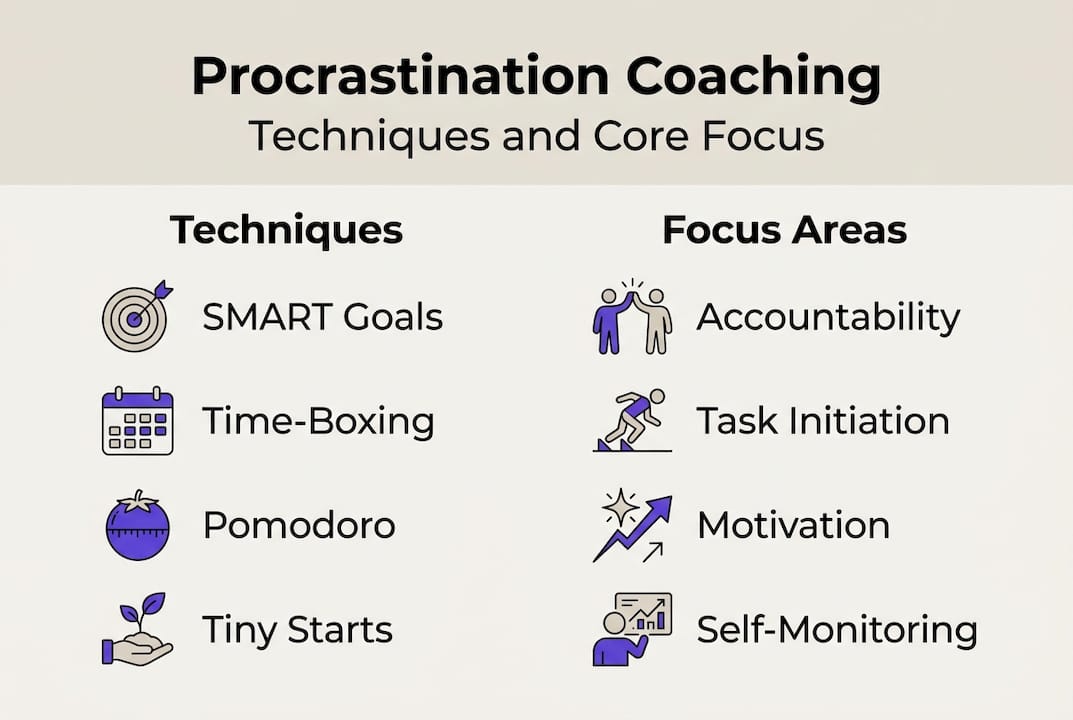
Tiny-start ladders reduce the intimidation of beginning. Instead of "write the report," coaches guide clients to commit to just five minutes of related activity: opening the document, reviewing notes, or outlining one section. This micro-commitment bypasses the emotional resistance that blocks task initiation. Once started, continuation becomes dramatically easier than the initial launch.
SMART goal frameworks transform vague intentions into concrete targets. "Be more productive" becomes "complete three priority tasks by 2pm daily for two weeks." Specificity eliminates ambiguity, measurability enables tracking, achievability prevents overwhelm, relevance maintains motivation, and time-bounds create urgency. This structure particularly helps students and professionals who struggle with open-ended or self-directed work.
Pomodoro technique and time-boxing impose external structure on unstructured time. Working in focused 25 minute intervals with 5 minute breaks creates manageable work chunks that feel less daunting than marathon sessions. The timer serves as an external commitment device, and scheduled breaks prevent the burnout that fuels future avoidance. For additional accountability strategies, see our guide on self-improvement strategies with AI accountability.
Behavioral activation counters avoidance by scheduling specific actions regardless of motivation levels. Coaches help clients commit to behavior first, trusting that engagement will generate momentum and positive feelings. This reverses the common trap of waiting to "feel ready" before starting, which perpetuates delay indefinitely.
Cognitive behavioral therapy and motivational interviewing techniques reshape the thought patterns driving procrastination. CBT identifies catastrophic thinking, all-or-nothing beliefs, and self-sabotaging narratives, then replaces them with realistic, compassionate self-talk. Motivational interviewing explores ambivalence, strengthens intrinsic motivation, and resolves the internal conflicts that manifest as procrastination.
Environment redesign removes friction from desired behaviors while adding friction to distractions. This might mean:
- Placing workout clothes beside the bed to reduce morning exercise barriers
- Using website blockers during designated focus hours
- Creating a dedicated workspace that signals work mode
- Scheduling tasks during peak energy windows identified through self-tracking
Weekly check-ins create accountability loops that prevent backsliding. Knowing you'll report progress to your coach increases follow-through rates significantly. These sessions also provide rapid feedback, allowing strategy adjustments before small setbacks become entrenched patterns.
Pro Tip: Pair your most dreaded task with something enjoyable. Listen to a favorite podcast only while doing admin work, or treat yourself to premium coffee only during morning focus blocks. This conditioning makes starting less painful.
Evidence and nuances: how effective is procrastination coaching?
The empirical case for procrastination coaching is compelling. A randomized controlled trial demonstrated that just 3 hours of coaching produced 68% remission rates among chronic procrastinators, with substantial reductions in severity scores and meaningful improvements in life satisfaction that persisted at one month follow-up. These results rival or exceed outcomes from far more intensive interventions, highlighting the leverage gained from targeting behavioral patterns directly.
The coaching approach differs fundamentally from therapy in focus and methodology. While therapy explores emotional roots and past experiences to heal psychological wounds, coaching concentrates on present behaviors and future goals to drive immediate action. Procrastination stems from emotion regulation and executive function challenges rather than deep trauma, making action-focused coaching particularly effective. Therapy remains appropriate when procrastination masks depression, anxiety disorders, or unresolved trauma requiring clinical treatment.
Different populations show distinct coaching needs and response patterns. High-performing professionals often procrastinate on strategic planning and creative work because these tasks lack clear endpoints and immediate feedback. Their coaching focuses on tolerance for ambiguity, breaking abstract goals into concrete milestones, and scheduling protected time for deep work.
Students struggle more with task initiation and sustained effort across long timeframes. Their coaching emphasizes external structure, regular check-ins, and techniques for managing the emotional discomfort of challenging academic work. Building self-compassion becomes critical, as harsh self-criticism after procrastination episodes fuels further avoidance.
Individuals with ADHD require coaching adaptations that account for working memory limitations, time blindness, and dopamine-seeking behaviors. Visual timers, body doubling, immediate rewards, and more frequent accountability touchpoints compensate for executive function deficits. For developmental approaches to lasting change, review our developmental coaching guide.
| Population | Primary Challenge | Coaching Focus |
|---|---|---|
| Professionals | Strategic work avoidance | Ambiguity tolerance, deep work scheduling |
| Students | Task initiation, sustained effort | External structure, self-compassion |
| ADHD individuals | Executive function deficits | Visual aids, body doubling, frequent check-ins |
| Perfectionists | Impossibly high standards | Progress over perfection, micro-wins |
Important nuances complicate simplistic narratives about procrastination. Strategic delay sometimes enhances outcomes when additional information, creative incubation, or priority clarification improves decision quality. The key distinction lies in intentional postponement versus anxious avoidance. Coaching helps clients recognize which pattern they're experiencing.
Avoid framing all procrastination as categorically bad or all immediate action as virtuous. Context matters. Rushing into poorly defined projects wastes more time than thoughtful delay that yields clarity. Effective coaching cultivates discernment about when to push through resistance and when to pause for strategic reasons.
"Procrastination coaching achieved 68% remission with just 3 hours of intervention, demonstrating remarkable efficiency in addressing chronic delay patterns through targeted behavioral strategies."
Pro Tip: Track your procrastination patterns for one week without judgment. Note which tasks you avoid, when avoidance peaks, and what you do instead. This data reveals your specific triggers and helps coaches design personalized interventions rather than generic advice.
AI-driven procrastination coaching: the next evolution in personalized support
Artificial intelligence is transforming procrastination coaching from a high-cost, limited-access service into a scalable, always-available support system. AI-powered applications like Dawdle AI, Ari, and Dopamind combine goal breakdown, adaptive timers, personalized nudges, and progress tracking to deliver science-backed coaching techniques 24/7. This technological shift dramatically expands access for students and professionals who need consistent accountability but lack time or resources for traditional coaching.
AI coaches excel at personalization through continuous learning. They analyze your completion patterns, energy fluctuations, and response to different intervention types, then adjust strategies in real time. If morning commitments consistently fail, the system shifts important tasks to your demonstrated peak performance windows. If gentle reminders prove ineffective, it escalates to more direct prompts or suggests environmental modifications.
Neurodiverse users particularly benefit from AI coaching features designed for executive function support. Visual progress bars provide concrete feedback that abstract time concepts cannot. Customizable notification frequencies accommodate varying attention needs. Break reminders prevent hyperfocus burnout. Task chunking algorithms automatically divide overwhelming projects into dopamine-friendly micro-tasks that feel achievable.
The around-the-clock availability addresses a critical gap in human coaching. Procrastination crises don't respect business hours. When Sunday night panic hits or a midday motivation crash threatens your afternoon productivity, AI coaches provide immediate intervention through encouraging messages, technique reminders, or brief accountability check-ins. This responsiveness prevents small lapses from cascading into complete derailment.
Leading AI procrastination coaching apps demonstrate varied approaches:
- Dawdle AI focuses on ADHD-specific features including body doubling simulation and dopamine-optimized reward systems
- Ari emphasizes natural language conversations that explore motivation and adjust goals collaboratively
- Dopamind integrates gamification elements with evidence-based behavioral techniques
- Coach Call AI combines voice interactions with WhatsApp integration for seamless daily accountability
These platforms don't necessarily replace human coaches but rather complement them by handling routine accountability while humans address complex psychological barriers or major strategy shifts. The hybrid model maximizes both consistency and depth. Explore how AI voice coaching enhances adherence rates.
| Feature | AI Coaching | Human Coaching |
|---|---|---|
| Availability | 24/7 instant access | Scheduled sessions |
| Cost | Low monthly subscription | High hourly rates |
| Personalization | Data-driven adaptation | Intuitive understanding |
| Emotional support | Limited empathy | Deep relational connection |
| Scalability | Unlimited users | Constrained by coach time |
AI coaching particularly suits individuals who:
- Need frequent check-ins throughout the day to maintain focus
- Prefer text-based interaction over face-to-face vulnerability
- Require immediate intervention during procrastination episodes
- Benefit from data visualization and objective progress tracking
- Want affordable ongoing support without long-term financial commitment
The technology continues advancing rapidly. Natural language processing improvements enable more nuanced conversations. Integration with productivity tools provides automatic progress tracking. Biometric data from wearables could eventually trigger interventions based on stress levels or attention patterns detected in real time. For comprehensive accountability strategies, see our guide on boosting accountability with AI personal development.
While AI coaching shows immense promise, current limitations include reduced emotional intelligence compared to humans, potential over-reliance on algorithmic suggestions, and privacy concerns around behavioral data collection. Choosing reputable platforms with transparent data practices and combining AI support with periodic human coaching creates an optimal balance for most users.
Discover AI accountability coaching for procrastination
If chronic procrastination is sabotaging your goals despite your best intentions, AI-powered accountability might provide the consistent support you need. Coach Call AI delivers personalized coaching through scheduled voice calls and WhatsApp integration, combining evidence-based techniques with 24/7 availability. The platform adapts to your unique procrastination patterns, offering timely nudges, progress tracking, and motivational support exactly when you need it most.
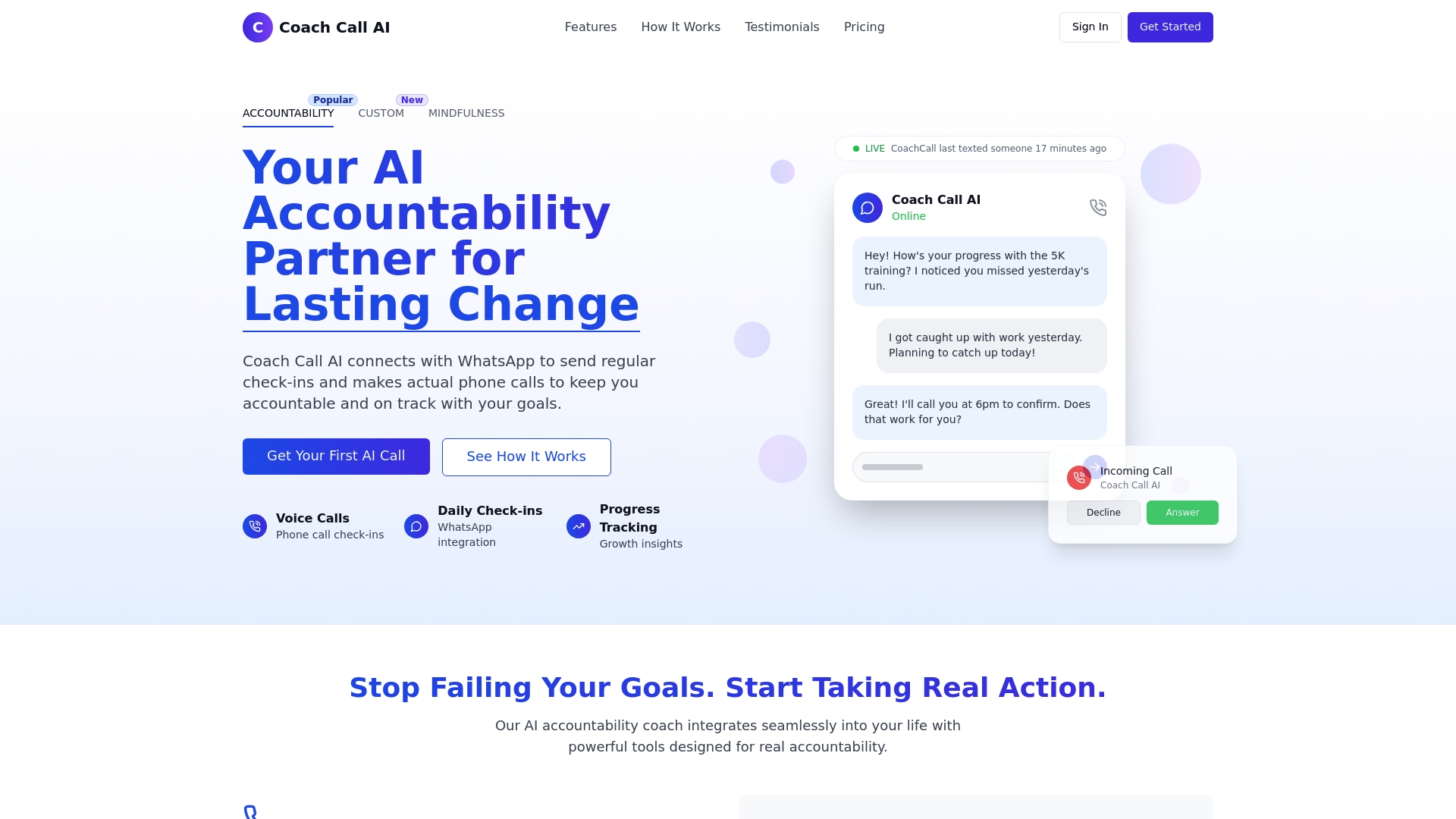
Designed for busy professionals and students who struggle with follow-through, Coach Call AI eliminates scheduling friction while maintaining the personal touch that drives accountability. The system learns your peak productivity windows, celebrates your wins, and intervenes during typical procrastination triggers. Instead of waiting for weekly coaching sessions, you receive continuous support that integrates seamlessly into your daily routine, turning inconsistent effort into reliable progress.
FAQ
What is the difference between procrastination coaching and therapy?
Coaching focuses on present behaviors and future goals through action-oriented strategies, while therapy explores emotional roots and past experiences to heal psychological issues. Procrastination coaching targets specific delay patterns with accountability frameworks and behavioral techniques. Therapy becomes necessary when procrastination masks clinical depression, anxiety disorders, or trauma requiring deeper psychological treatment.
How does AI enhance procrastination coaching effectiveness?
AI provides scalable 24/7 support with personalized nudges, progress tracking, and immediate intervention during procrastination episodes. The technology analyzes your patterns to optimize timing, task breakdown, and reminder intensity. Adaptive algorithms adjust strategies based on your responses, delivering consistent accountability without the scheduling constraints and cost barriers of human coaching.
Who should consider procrastination coaching?
Anyone experiencing chronic delay that impacts goals, deadlines, or well-being should explore coaching. Students struggling with assignment paralysis, professionals avoiding strategic work, and neurodiverse individuals with executive function challenges gain particular benefit. Coaching proves most effective when procrastination stems from behavioral patterns rather than clinical mental health conditions requiring therapy.
How long does procrastination coaching take to show results?
Research shows significant improvement after just 3 hours of targeted coaching, with 68% of participants achieving remission from chronic procrastination. Most structured programs run four to six weeks with weekly sessions, though individual timelines vary based on procrastination severity and consistency applying techniques. Early wins often appear within the first two weeks as initial strategies reduce task initiation barriers.
Can procrastination coaching help with ADHD-related delays?
Yes, coaching specifically adapted for ADHD addresses executive function deficits through visual timers, body doubling, frequent check-ins, and dopamine-optimized task structures. These modifications compensate for working memory limitations and time blindness common in ADHD. However, coaching works best alongside appropriate medical treatment and should complement rather than replace clinical ADHD management.