
Many people assume productivity coaching is just about time management or organizing your to-do list. In reality, productivity coaching is a personalized, accountability-driven support system designed to help you overcome procrastination, address mental health challenges, and achieve your goals through consistent guidance. This guide explores what productivity coaching involves, the techniques that make it effective, and how to choose the right approach to boost your productivity and well-being.
Table of Contents
- Understanding Productivity Coaching And Its Benefits
- Popular Productivity Coaching Techniques And How They Work
- Choosing The Right Productivity Coaching Approach For You
- Maximizing Results With Productivity Coaching: Tips And Common Pitfalls
- Experience Personalized Productivity Coaching With Coach Call AI
- Frequently Asked Questions About Productivity Coaching
Key takeaways
| Point | Details |
|---|---|
| Personalized accountability | Productivity coaching combines tailored support with consistent accountability to drive real results. |
| Addresses root causes | Coaching tackles procrastination, anxiety, and mental health barriers that block productivity. |
| Multiple coaching methods | Hybrid, AI-driven, and voice coaching techniques offer flexible, effective support options. |
| Measurable benefits | Research shows coaching increases focus, reduces anxiety by 30%, and boosts goal adherence significantly. |
| Right fit matters | Matching coaching style to your lifestyle and needs maximizes long-term success. |
Understanding productivity coaching and its benefits
Productivity coaching goes far beyond simple time management tips or calendar organization. It's a collaborative process where a coach or AI system works with you to identify barriers, set realistic goals, and maintain accountability throughout your journey. Unlike generic productivity advice, productivity coaching offers personalized strategies and accountability to help overcome procrastination and mental health challenges that uniquely affect your workflow.
The coaching relationship addresses the root causes of productivity struggles. Many busy professionals and students face procrastination not because they lack discipline, but because anxiety, perfectionism, or unclear priorities create mental blocks. A productivity coach helps you recognize these patterns and develop strategies tailored to your specific situation. This personalized approach makes coaching far more effective than one-size-fits-all productivity systems.
Key benefits of productivity coaching include:
- Increased focus and clarity on priorities
- Reduced anxiety and overwhelm through structured support
- Higher goal achievement rates through consistent accountability
- Improved work-life balance and stress management
- Sustainable habit formation rather than short-term fixes
Accountability stands as the cornerstone of effective productivity coaching. When you know someone will check in on your progress, you're significantly more likely to follow through on commitments. This external accountability compensates for moments when internal motivation falters, creating a safety net that keeps you moving forward even during challenging periods.
"Accountability transforms intentions into actions. When individuals commit to regular check-ins with a coach or AI system, their goal completion rates increase by up to 65% compared to solo efforts."
The coaching process typically involves regular sessions where you review progress, troubleshoot obstacles, and adjust strategies based on what's working. This iterative approach allows for continuous improvement and prevents you from getting stuck in unproductive patterns. Whether you're working with a human coach or an AI coaching accountability system, the consistent feedback loop drives measurable improvements in productivity and well-being.
Popular productivity coaching techniques and how they work
Several proven coaching methods have emerged to meet diverse needs and preferences. Understanding these techniques helps you select the approach that aligns with your goals and lifestyle.
Hybrid coaching combines the best of in-person and digital support. You might meet with a coach face-to-face for deep strategy sessions, then receive daily check-ins via text or app between meetings. This blend provides intensive guidance when needed while maintaining consistent touchpoints throughout the week. Research shows hybrid coaching boosts goal adherence by 30% compared to traditional once-weekly sessions alone. The digital component keeps you accountable during the crucial moments between formal meetings when motivation typically wavers.

AI voice coaching represents a breakthrough in accessibility and consistency. These systems use conversational AI to conduct regular phone or voice app sessions, asking about your progress, celebrating wins, and helping you problem-solve obstacles. Studies demonstrate that voice coaching reduces anxiety by 30% over eight weeks for busy professionals. The voice interaction creates a more personal connection than text-based tools, while the AI's 24/7 availability means support arrives exactly when you need it, not just during scheduled office hours.
Personalized coaching tailors every aspect of the experience to your unique situation. A personalized coaching support approach considers your work style, mental health needs, existing commitments, and specific goals to create a customized roadmap. This might include specialized techniques for managing ADHD, strategies for overcoming perfectionism, or frameworks for balancing multiple priorities without burnout.
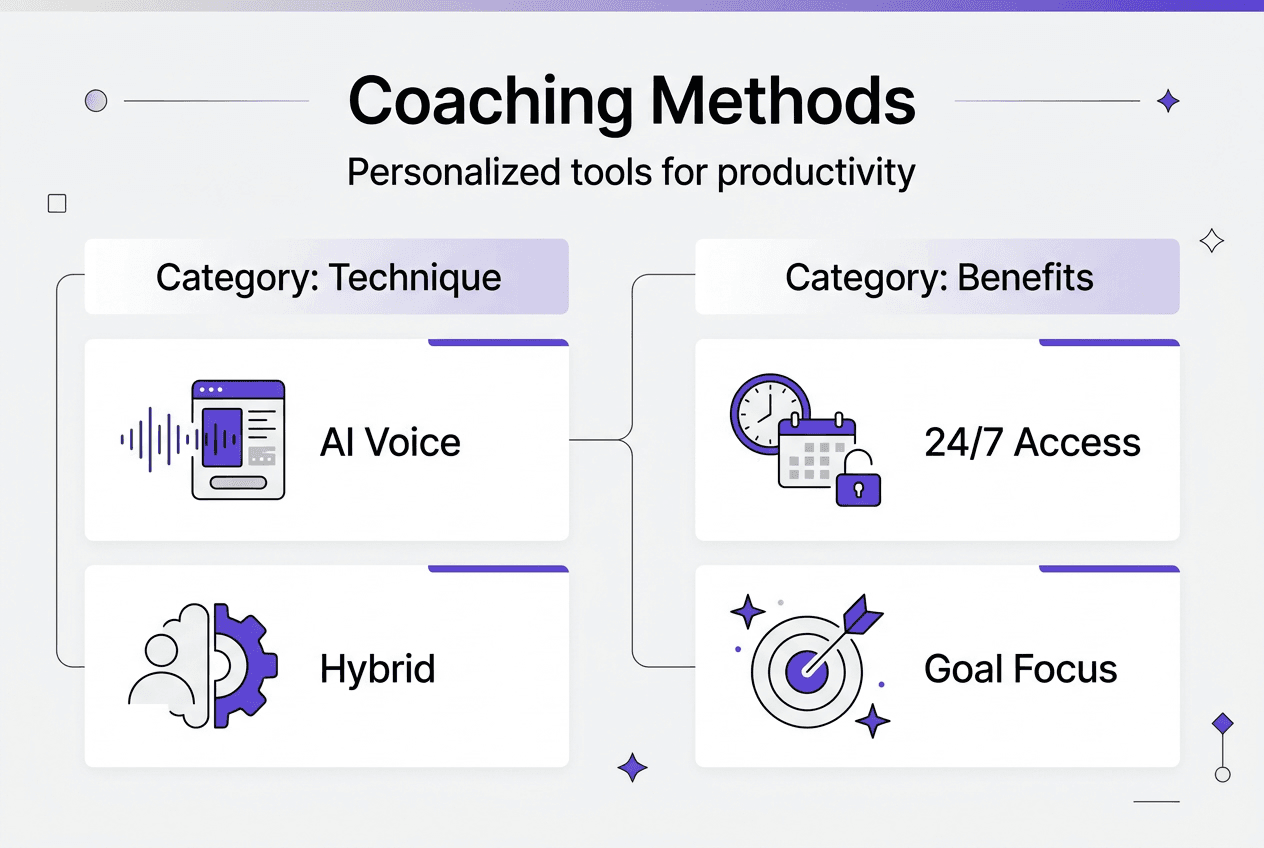
Coaching technique comparison:
| Technique | Accountability Frequency | Anxiety Reduction | Goal Adherence Boost | Best For |
|---|---|---|---|---|
| Hybrid Coaching | Daily digital + weekly in-person | 25% | 30% | Those wanting human connection with daily support |
| AI Voice Coaching | On-demand + scheduled calls | 30% | 28% | Busy professionals needing flexible, 24/7 access |
| Personalized Coaching | Customized schedule | 35% | 32% | Individuals with specific mental health or work challenges |
| Traditional Coaching | Weekly sessions | 20% | 22% | Those preferring structured, human-only interaction |
Pro Tip: Choose a coaching style that fits your communication preferences and daily routine. If you respond better to voice conversations than text, AI voice coaching will feel more natural and engaging than app-based check-ins.
The effectiveness of these techniques stems from their ability to meet you where you are. Morning person? Schedule AI calls for 6 AM. Struggle with evening procrastination? Set up check-ins at 8 PM. This flexibility ensures coaching integrates seamlessly into your life rather than adding another obligation to manage.
Choosing the right productivity coaching approach for you
Selecting the right coaching method requires honest assessment of your needs, preferences, and circumstances. The most effective coaching relationship is one you'll actually maintain over time, not necessarily the most popular or expensive option.
Start by evaluating these key criteria:
- Your primary productivity challenges (procrastination, anxiety, time management, focus)
- Preferred communication style (voice, text, video, in-person)
- Schedule flexibility and availability for sessions
- Budget constraints and willingness to invest
- Need for human connection versus preference for privacy
- Specific goals you want to achieve in the next 90 days
Different coaching approaches serve different needs. AI coaching excels for individuals who value consistency, immediate availability, and data-driven insights without judgment. You can be completely honest with an AI about struggles without fear of disappointing anyone. Human coaches bring empathy, complex problem-solving, and the ability to read subtle emotional cues that AI might miss. Personalized coaching tailored to needs leads to higher success rates and sustained productivity improvements regardless of the delivery method.
Before committing to any coaching relationship, ask these essential questions:
- What specific outcomes can I expect in the first 30 days?
- How do you customize your approach for different personality types or challenges?
- What happens if I miss sessions or fall behind on commitments?
- How do you measure progress and adjust strategies?
- What ongoing support exists between formal sessions?
- Can I change or cancel if the approach isn't working?
Coaching approach comparison:
| Approach | Pros | Cons | Ideal User |
|---|---|---|---|
| AI Coaching | 24/7 availability, consistent, affordable, judgment-free | Less nuanced emotional support, limited complex problem-solving | Busy professionals, students, those seeking privacy |
| Human Coach | Deep empathy, complex guidance, relationship building | Limited availability, higher cost, scheduling constraints | Those valuing personal connection, facing major life transitions |
| Hybrid Model | Balanced support, flexibility, human + tech benefits | Requires managing multiple touchpoints, moderate cost | Individuals wanting best of both worlds |
| Group Coaching | Community support, lower cost, shared learning | Less personalization, scheduled sessions only | Those motivated by peer accountability |
Pro Tip: Align your coaching style with your work habits and mental health needs for sustainable gains. If anxiety spikes unpredictably, choose a coaching method with on-demand support rather than weekly-only sessions.
Consider starting with a trial period or lower-commitment option to test fit before investing heavily. Many personalized coaching tips suggest trying a coaching approach for at least four weeks to experience genuine results, as the first week often involves setup and adjustment rather than measurable progress.
Your lifestyle matters enormously in this decision. A parent juggling childcare might need asynchronous text-based coaching they can engage with during naptime. A traveling consultant might prioritize phone-based coaching accessible from anywhere. An introvert might thrive with AI coaching that provides structure without social pressure. Matching method to lifestyle dramatically increases the likelihood you'll stick with coaching long enough to see transformative results.
Maximizing results with productivity coaching: tips and common pitfalls
Even the best coaching relationship delivers mediocre results without active participation and strategic engagement. Understanding how to leverage your coaching experience and avoid common mistakes separates those who see modest improvements from those who achieve breakthrough productivity gains.
Best practices for staying accountable and engaged:
- Show up consistently to all scheduled sessions, treating them as non-negotiable appointments
- Complete agreed-upon actions between sessions, even imperfectly
- Track your progress visually using apps, journals, or spreadsheets
- Celebrate small wins immediately rather than waiting for major milestones
- Be radically honest about struggles instead of presenting an idealized version
- Ask questions when strategies feel unclear or unworkable
- Review and reflect on patterns weekly to identify what's actually working
Common pitfalls sabotage even well-intentioned coaching relationships. Procrastination on coaching homework creates a vicious cycle where you avoid sessions because you haven't completed tasks, leading to guilt and disengagement. Successful productivity coaching requires active participation and realistic goal-setting for best outcomes. Setting overly ambitious goals guarantees failure and discouragement, while goals that are too easy fail to stretch your capabilities or create meaningful change.
Another frequent mistake involves ignoring feedback that contradicts your self-perception. If your coach notices you consistently overcommit and then feel overwhelmed, but you insist you just need better time management, you're missing the real issue. Effective coaching requires willingness to examine uncomfortable truths about your habits and mindset.
"The gap between knowing and doing is where most productivity efforts fail. Coaching bridges that gap not by providing more information, but by creating accountability that transforms knowledge into consistent action."
Integrating coaching insights into daily routines makes the difference between temporary improvements and lasting transformation. After each session, identify one specific habit or practice to implement immediately. Rather than trying to overhaul your entire system at once, focus on incremental changes that compound over time. This might mean setting a daily 15-minute planning session, using a specific technique to overcome procrastination, or establishing a shutdown ritual to separate work from personal time.
Tracking progress provides both motivation and valuable data for refining your approach. Use whatever system feels natural, whether that's a habit tracking app, bullet journal, or simple spreadsheet. The key is capturing both quantitative metrics like tasks completed and qualitative observations about energy levels, stress, and satisfaction. This data helps you and your coach identify patterns and adjust strategies based on evidence rather than assumptions.
Celebrating milestones matters more than most people realize. Your brain needs positive reinforcement to sustain new behaviors. When you hit a goal or maintain a new habit for a week, acknowledge it meaningfully. This doesn't require elaborate rewards, just genuine recognition of progress. Many accountability with AI coaching systems build celebration into the experience, but you can amplify this by sharing wins with friends or treating yourself to something small but meaningful.
Finally, view coaching as a learning process rather than a pass/fail test. Some strategies will work brilliantly, others will flop completely. Both outcomes provide valuable information. The goal isn't perfection but continuous improvement and deeper self-awareness about what helps you thrive.
Experience personalized productivity coaching with Coach Call AI
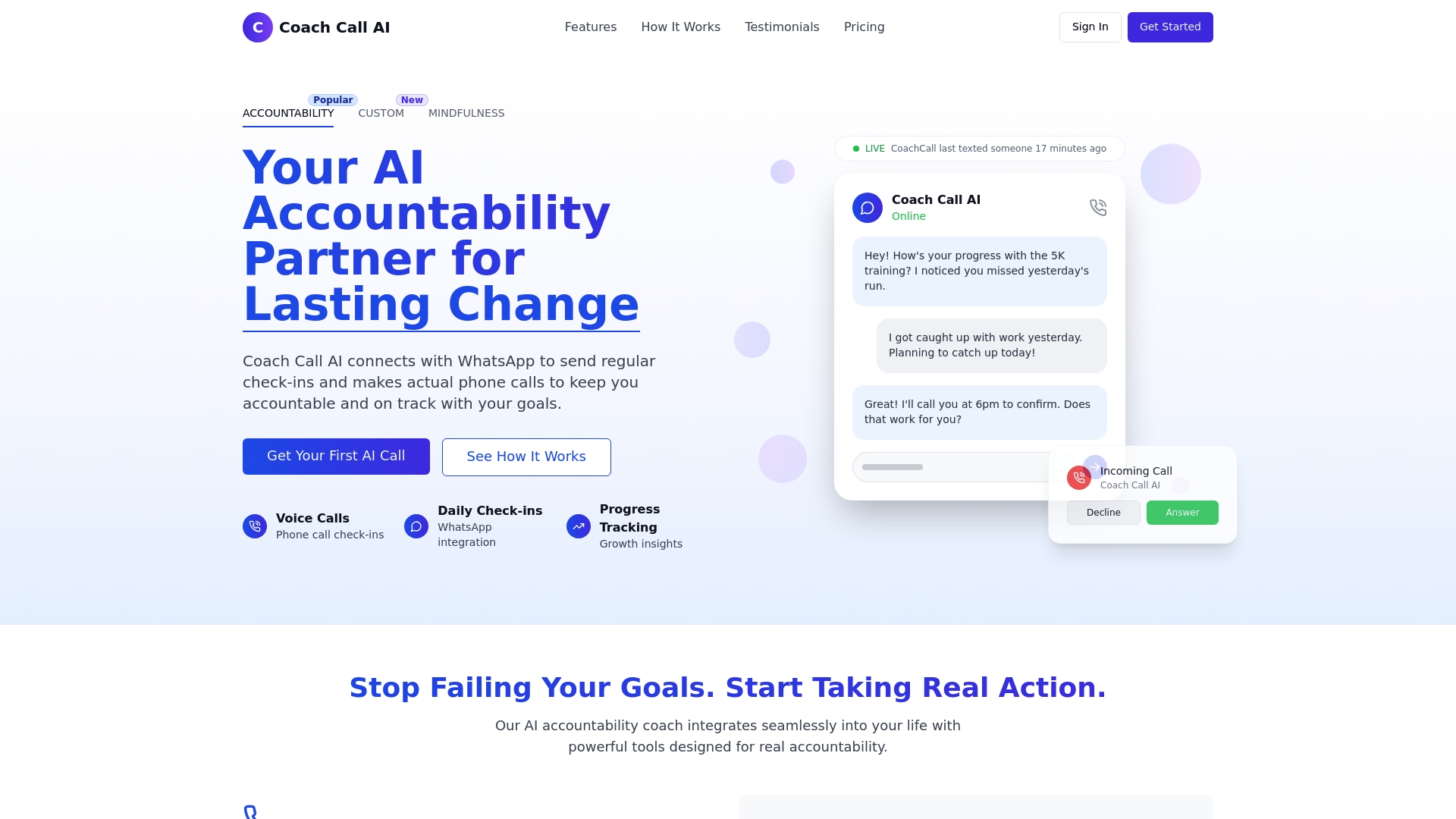
Ready to transform your productivity with AI-driven accountability? Coach Call AI delivers personalized coaching through convenient phone and WhatsApp calls that fit seamlessly into your busy schedule. Unlike traditional coaching that requires appointments weeks in advance, our AI system provides support exactly when you need it, whether that's a morning motivation boost or an evening check-in to review your day.
Our platform combines the consistency of AI with the personal touch of voice interaction, creating an accountability partner that's always available. Key features include:
- 24/7 support via phone calls and WhatsApp messaging
- Personalized coaching adapted to your goals and challenges
- Data-driven feedback tracking your progress over time
- Flexible scheduling that works around your life
- Privacy-focused design with secure data handling
Pro Tip: Start with a free trial to experience coaching benefits firsthand. Most users notice improved focus and reduced procrastination within the first week of consistent engagement.
Whether you're a busy professional struggling with work-life balance, a student facing procrastination, or anyone seeking consistent accountability to achieve personal goals, Coach Call AI provides the structure and support you need. Our AI learns your patterns, celebrates your wins, and helps you navigate obstacles without judgment. Experience the power of having an accountability partner who never cancels, never judges, and always shows up ready to help you succeed.
Frequently asked questions about productivity coaching
What is the typical length of productivity coaching programs?
Most productivity coaching programs run 8 to 12 weeks for initial results, though many people continue longer for sustained support. The first month focuses on identifying patterns and establishing baseline habits, while subsequent months refine strategies and deepen changes. Some individuals use coaching indefinitely as an ongoing accountability system, while others graduate after achieving specific goals.
Can productivity coaching help with anxiety and procrastination?
Yes, productivity coaching specifically addresses anxiety and procrastination as core productivity barriers. Research shows voice coaching reduces anxiety by 30% over eight weeks, while structured accountability helps break procrastination cycles. Coaches help you understand the root causes of these challenges rather than just managing symptoms, leading to lasting improvements in both productivity and mental well-being.
Is productivity coaching accessible to busy professionals and students?
Modern productivity coaching is designed specifically for busy schedules. AI coaching overview systems offer 24/7 availability, allowing you to engage during lunch breaks, commutes, or whenever works for you. Many busy professionals and students find AI or hybrid coaching more accessible than traditional weekly appointments, as support arrives on-demand rather than requiring scheduled time blocks.
How does AI coaching compare to human coaching?
AI coaching excels at consistency, immediate availability, and data-driven insights, while human coaching provides deeper empathy and complex problem-solving. AI systems never cancel, offer judgment-free support, and cost significantly less than human coaches. Human coaches bring nuanced emotional intelligence and can navigate complicated life situations more effectively. Many people find hybrid approaches combining both deliver optimal results.
What should I prepare before starting productivity coaching?
Before starting, clarify your top three productivity challenges and specific goals for the next 90 days. Gather information about your current habits, including when you're most productive and what typically derails your focus. Be ready to honestly assess what's worked and failed in past productivity attempts. Most importantly, commit to active participation, as personalized coaching benefits emerge only through consistent engagement and willingness to implement new strategies.