
AI-powered coaching has moved far beyond simple chatbots and pre-written motivational scripts. Today, intelligent coaching support refers to systems that use machine learning, natural language processing, and generative AI to deliver personalized, scalable, on-demand guidance across fitness, productivity, mental well-being, and personal development. These platforms adapt to your behavior in real time, track your progress automatically, and hold you accountable in ways that a weekly check-in with a human coach simply cannot match. If you have ever struggled to stay consistent with your goals, this technology was built for you.
Table of Contents
- What is intelligent coaching support?
- How intelligent coaching systems work
- Methodologies and frameworks: Adaptive, hybrid, and data-driven
- Benefits and impact: Evidence-backed results
- Limitations and ethical considerations
- Practical applications: Personal development, productivity, fitness, and mental well-being
- Ready to unlock consistent accountability?
- Frequently asked questions
Key Takeaways
| Point | Details |
|---|---|
| AI coaching defined | Intelligent coaching support uses advanced AI to deliver personalized, scalable guidance for personal growth and accountability. |
| Real-time adaptive support | AI-driven coaching provides on-demand feedback and plan adjustments using behavioral analytics and wearable integrations. |
| Hybrid models best | Combining AI and human expertise offers the most effective balance of scalability and emotional nuance. |
| Empirical results | AI coaching solutions improve retention and health outcomes, with specialized systems vastly outperforming generic LLMs. |
| Ethical oversight needed | AI coaching must remain transparent and adhere to ongoing ethical standards for safe, effective support. |
What is intelligent coaching support?
Intelligent coaching support is not a glorified FAQ bot. It is a category of AI-powered systems that deliver personalized, scalable coaching using machine learning, NLP, and generative AI to provide real-time guidance, feedback, and adaptive plans. The shift from static digital tools to these dynamic systems happened gradually, driven by advances in large language models and behavioral data science.
Three core technologies power these platforms:
- Machine learning analyzes your past behavior to predict what support you need next
- Natural language processing (NLP) enables fluid, human-like conversations that feel responsive rather than scripted
- Generative AI creates personalized plans, reflections, and feedback on the fly
What makes this different from a fitness app or a productivity tracker is the combination of all three. AI voice coaching adds another layer by enabling spoken interactions that feel closer to a real coaching session. The result is a system that learns you, adapts to you, and shows up consistently, which is exactly what most people need to build lasting habits. As AI coaching explained by leading researchers, the real value lies in behavioral continuity, not just information delivery.
How intelligent coaching systems work
Understanding the mechanics helps you use these tools more effectively. At the core, intelligent coaching systems rely on conversational interfaces that ask adaptive questions, adjust based on your answers, and guide you through structured reflection. This is not a static survey. It is a dynamic dialog that evolves with every session.
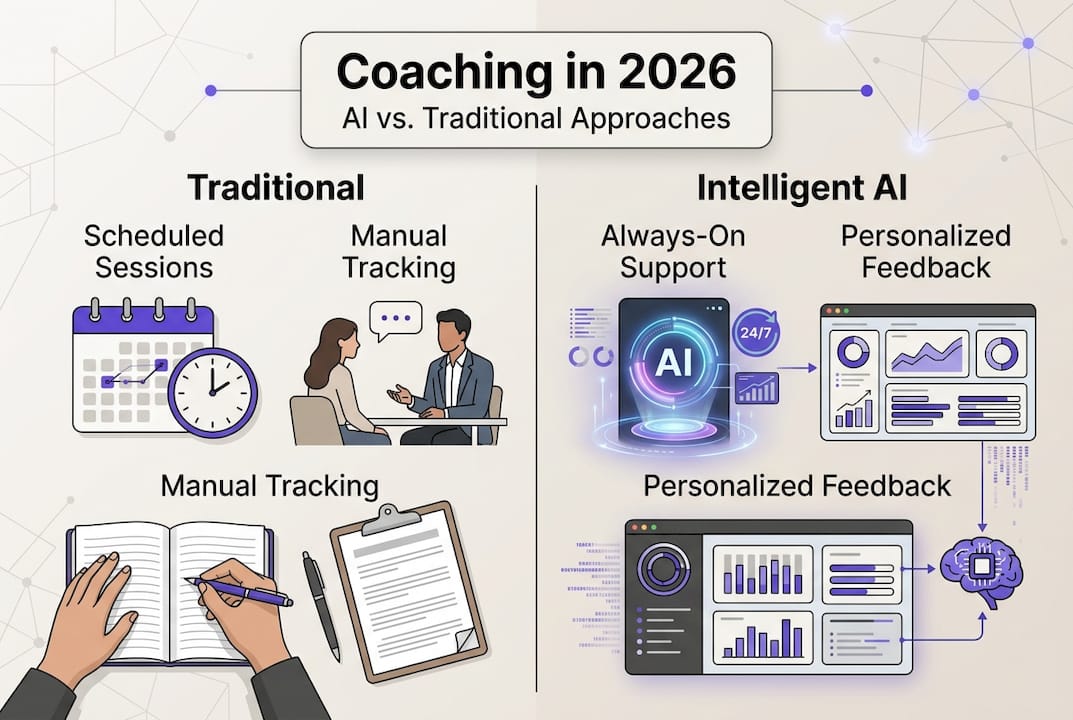
Here is a quick comparison of traditional versus intelligent coaching mechanics:
| Feature | Traditional coaching | Intelligent coaching |
|---|---|---|
| Availability | Scheduled sessions | Always-on, 24/7 |
| Personalization | Human judgment | Data-driven adaptation |
| Feedback speed | Days or weeks | Real-time |
| Scalability | Limited by human capacity | Unlimited users |
| Biometric integration | Rare | Common (HRV, sleep, steps) |
The mechanics of AI coaching include conversational interfaces for adaptive questioning, role-playing simulations, behavioral analytics, integration with wearables for biometric data like HRV and sleep, and multi-mode architectures that reduce cognitive load and match user intent. These modes include reflection, practice, and retrieval, each serving a different stage of behavior change.
Key capabilities that set intelligent systems apart:
- Wearable integration tracks sleep quality, heart rate variability, and activity levels
- Behavioral analytics identify patterns and flag when you are drifting off track
- Behavioral coaching frameworks guide the AI to ask the right questions at the right time
- AI training tools simulate real-world scenarios for skill-building and confidence
Pro Tip: If you are new to AI coaching, start with one goal and one mode, such as daily reflection check-ins, before layering in wearable data or voice sessions. Overloading the system early reduces the quality of its personalization.
Methodologies and frameworks: Adaptive, hybrid, and data-driven
The best intelligent coaching systems do not just react to your inputs. They follow structured methodologies that are grounded in behavioral science and professional coaching standards. Continuous, data-driven adaptation over episodic sessions, hybrid human-AI models for scalability, and research-backed frameworks like ICF standards define the leading approaches in 2026.

Here is how the main methodologies compare:
| Methodology | Best for | Key strength |
|---|---|---|
| Continuous AI adaptation | Daily habit building | Always-on accountability |
| Hybrid human-AI | Complex emotional goals | Empathy plus scalability |
| Episodic AI sessions | Skill development sprints | Focused, structured learning |
| Data-driven frameworks | Fitness and health goals | Evidence-based adjustments |
The four steps most effective intelligent coaching programs follow:
- Goal setting with specificity and measurable milestones
- Behavioral baseline established through initial data collection
- Adaptive plan delivery that shifts based on your real-time progress
- Milestone celebration and recalibration to maintain motivation and direction
Hybrid coaching models are gaining traction because they combine the scalability of AI with the emotional nuance of human coaches. For high-stakes goals like career transitions or mental health support, this combination is not optional. It is essential. AI leadership coaching research confirms that hybrid models consistently outperform pure AI or pure human approaches in sustained behavior change.
Benefits and impact: Evidence-backed results
The numbers behind intelligent coaching support are hard to ignore. Specialized AI coaching systems outperform general LLMs by 48 to 108% in leadership benchmarks, and HRV-guided training boosts VO2 max by 6 to 10%. These are not marginal gains. They represent meaningful improvements in real-world performance.
Key findings from recent research:
- AI coaching in health digital health interventions improves engagement and retention up to 56%
- Daily step counts increase by over 1,675 steps when AI accountability is active
- Specialized coaching AI outperforms general-purpose models by up to 108% on domain-specific benchmarks
- The AI coaching market is projected to grow from $8.16 billion in 2025 to $30.77 billion by 2034
"Specialized AI coaching systems consistently outperform general large language models in domain-specific benchmarks, with gains ranging from 48% to 108% depending on the coaching context."
These results connect directly to what AI self-improvement strategies research shows: consistency and personalization are the two biggest drivers of lasting change. AI delivers both at scale, which is why adoption is accelerating across fitness, productivity, and mental well-being sectors.
Limitations and ethical considerations
Intelligent coaching support is powerful, but it is not perfect. AI coaching lacks physical form observation, emotional depth, and the ability to handle novel contexts, and it struggles with edge cases in simulations, adversarial prompts, or high-stakes emotional support. Knowing these limits helps you use the technology wisely.
The most common limitations include:
- Cannot observe body language, tone of voice, or physical form during exercise
- Tends toward safe, generic advice when facing emotionally complex situations
- May reinforce existing patterns rather than challenging deeply held beliefs
- Requires ongoing ethical oversight aligned with ICF standards to prevent harm
Over-reliance is a real risk. If you treat AI coaching as a replacement for human connection during a mental health crisis, you are using the wrong tool for the job. AI coaching accountability works best when it supplements your support network, not replaces it. For a broader picture of what these tools can and cannot do, reviewing what AI coaching actually is helps set realistic expectations.
Pro Tip: Schedule a monthly review with a human mentor or coach to audit your AI coaching experience. This keeps you honest about whether the AI is challenging you or just validating you.
Practical applications: Personal development, productivity, fitness, and mental well-being
Intelligent coaching support is most effective when applied to specific, measurable goals. Always-on, personalized support is ideal for personal development, productivity, and fitness, and works best as a hybrid with human coaching for empathy and nuance. Here is how to put it into practice across four key areas:
- Personal development: Use daily reflection prompts to track mindset shifts and identify recurring obstacles. Pair with journaling for deeper self-awareness.
- Productivity: Set weekly output goals and let the AI send check-in reminders, flag missed milestones, and adjust your plan based on completion rates.
- Fitness: Connect wearables to get adaptive workout and recovery recommendations based on HRV, sleep quality, and activity trends.
- Mental well-being: Use structured check-ins to monitor stress levels and mood patterns. Explore mental well-being coaching strategies that combine AI prompts with mindfulness practices.
For best results, treat your AI coach like a training partner, not a vending machine. The more honest and consistent your inputs, the more accurate and useful the feedback becomes. Personalized coaching support research confirms that user engagement quality directly predicts outcome quality. CultureAmp AI leadership data also shows that teams using AI coaching tools with structured human oversight see the strongest long-term results.
Pro Tip: Alternate between reflection mode and practice mode each week. Reflection builds self-awareness; practice builds skill. Using both prevents the common trap of knowing what to do without actually doing it.
Ready to unlock consistent accountability?
Everything covered in this article points to one practical truth: intelligent coaching support works when it is consistent, personalized, and integrated into your daily routine. That is exactly what Coach Call AI is built to deliver.
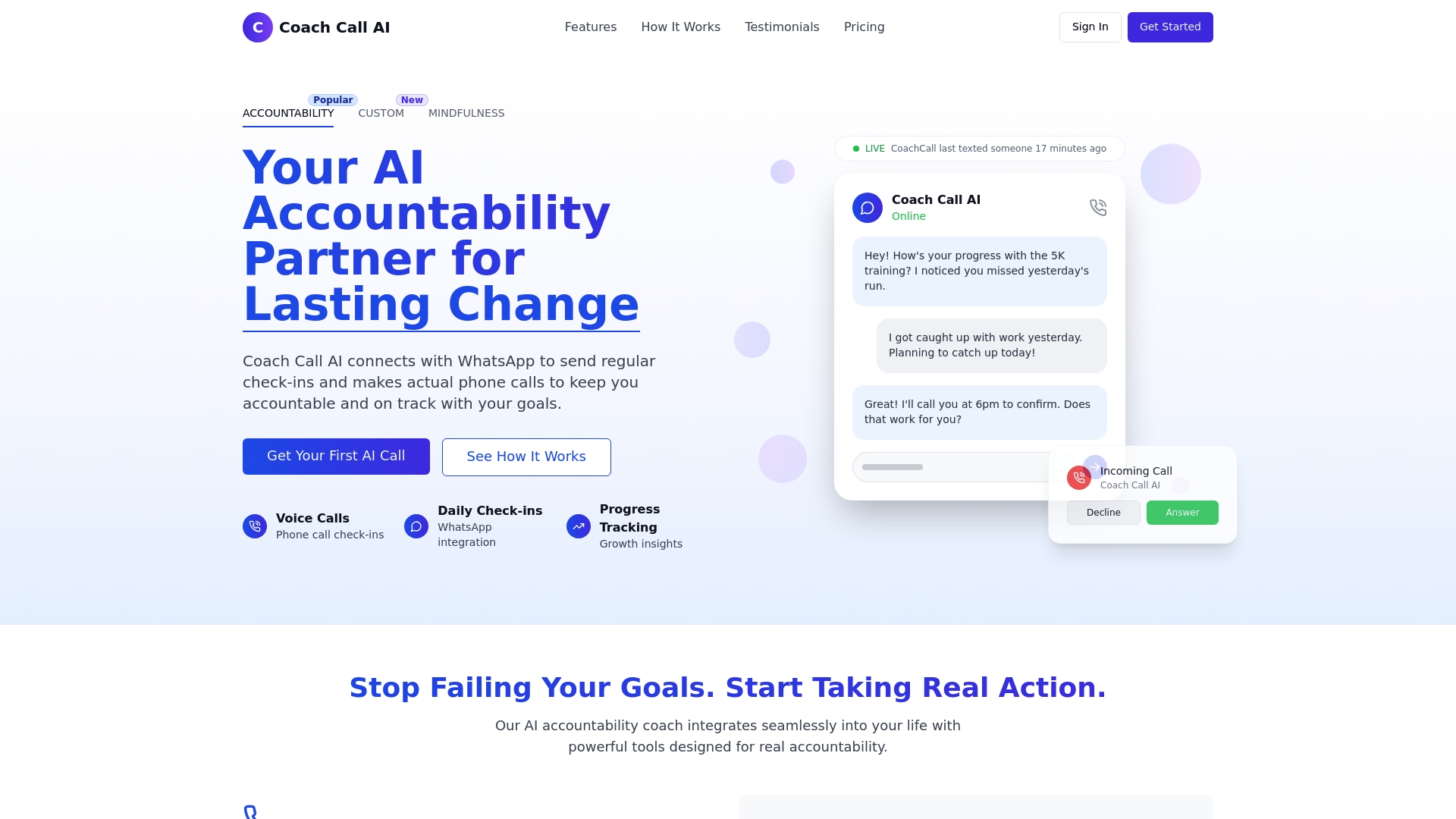
Coach Call AI connects with you through WhatsApp and scheduled voice calls, providing real-time check-ins, adaptive feedback, and milestone tracking without requiring you to download another app or block time on your calendar. Whether your focus is fitness, productivity, mental well-being, or personal growth, the platform adapts to your goals and keeps you moving forward. It is always-on accountability that fits your life, not the other way around. Start building the consistency that actually leads to results.
Frequently asked questions
How does intelligent coaching support differ from traditional coaching?
Intelligent coaching support uses AI to deliver real-time, adaptive guidance continuously, while traditional coaching relies on scheduled sessions and human interpretation. The key difference is availability and speed of feedback.
Can AI-driven coaching actually improve health and fitness outcomes?
Yes. Studies show retention rates up to 56%, daily step increases of over 1,675, and VO2 max improvements of 6 to 10% when AI-integrated coaching systems are used consistently.
What are the main limitations of intelligent coaching support?
AI coaching lacks emotional depth and struggles with complex emotional challenges, novel contexts, and situations requiring physical observation. It works best alongside human support for high-stakes goals.
Is hybrid AI-human coaching more effective than pure AI?
Hybrid coaching is recommended for optimal results, combining AI's scalability with human empathy. Research-backed frameworks like ICF standards support this blended approach for sustained behavior change.
Can intelligent coaching support be integrated with wearables?
Yes. Many AI coaching platforms integrate with wearables to track biometrics like HRV and sleep data, enabling adaptive, evidence-based guidance that responds to your actual physical state.